

Work Is a Product. Who Designs Yours?
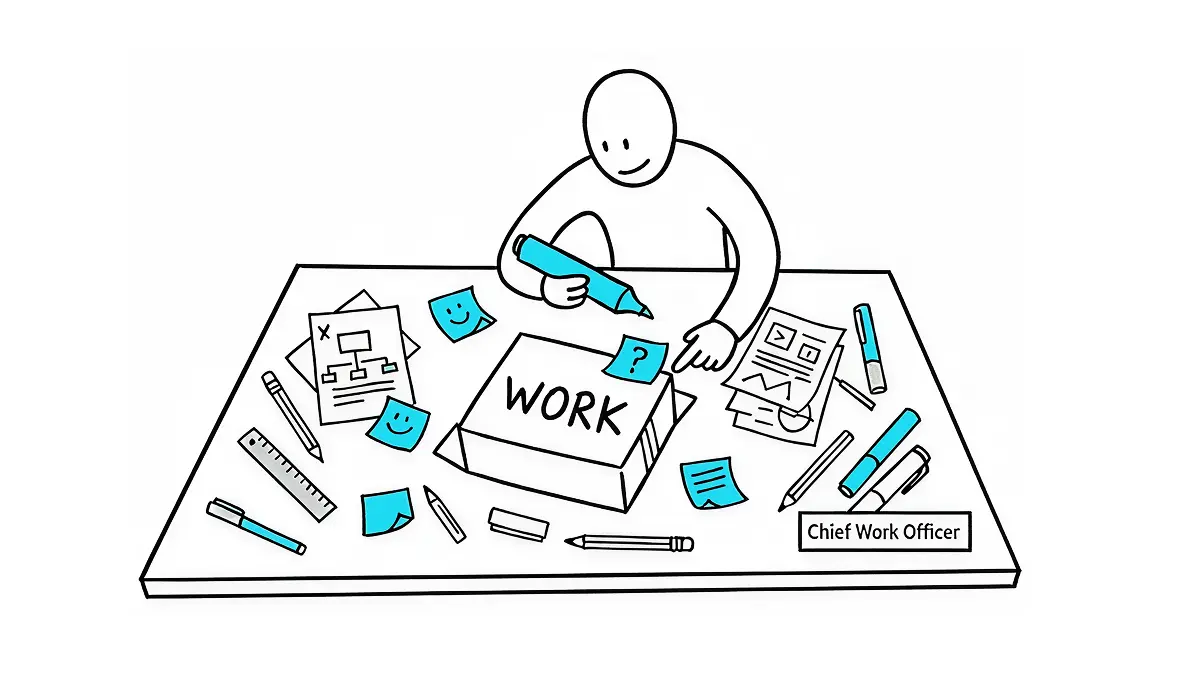
I keep finding new angles on the Chief of Work, and four fabulous female leaders are showing me what I was missing.
Last week, I wrote about Lynn Roger, who accidentally built a Chief of Work function at BMO years ago, breaking down silos between HR, IT, and CRE to transform the work and place.
I heard Dropbox CHRO Melanie Rosenwasser describe their "HR as a Product" framework on the Work For Humans podcast. Tough Day CEO Katherine von Jan (“KVJ”) also released a Tough Day podcast interview with me, in which we discussed why workplace transformations fail despite good intentions.
KVJ first emailed me in response to my Chief of Work article, then hired Jill Unikel as Tough Day’s Chief Work Officer. Tough Day provides AI-powered confidential support that helps employees become more self-reliant while elevating managers into leaders—designed for flatter organizations with greater spans of control.


At BMO, Lynn influenced a massive workforce at BMO, but Tough Day has fewer than a dozen employees. So what is Jill the 'Chief' of when the company fits in a conference room? She's not managing work at scale within one organization; she's designing work as a product that scales across organizations.
My conversations with Jill and KVJ, bolstered by Melanie’s podcast and Lynn’s lessons learned, revealed three core principles that separate product thinking from traditional workplace management. The starting point is deceptively simple: who is your customer?
Employees Are A Customer
"The main customers when you're on an internal team are your stakeholders, your leaders, and your employees," Jill told me.
Product managers understand this instinctively; users determine success. Jill describes the goal as "winning our employees' renewal" every day so they return ready to bring their best. Melanie at Dropbox mirrors that language: over 90% of their employees cite Virtual First as the reason they "keep subscribing" to the company.
The metric shift follows naturally:
- OLD: "Are people completing their performance reviews?"
- NEW: "Are they driving the performance the business needs and giving employees the feedback needed to grow?"
Not compliance or adoption rates, but whether the work works for all internal customers—which is what drives the renewal.
Jill's definition of her role operationalizes this customer mindset:
The intersection between employee experience, what companies actually need and the problems they need to solve, and building technology to solve for that.
This means simultaneously understanding how people actually work, identifying which business problems matter most, and translating both into technology and process design.
As Jill notes: if a leader isn't behind an internal initiative, "it's not getting done." The CWO bridges what employees need with what the business requires.
Lead Across the Lines of Modern Work with Phil Kirschner
Over 22,000 professionals follow my insights on LinkedIn.
Join them and get my best advice straight to your inbox.
Continuous Iteration
The second principle: treat work as something you continuously improve, not something you fix once. Jill saw it firsthand at Salesforce: 'Five years later, we were solving the same problems at a different scale.'
This is why product thinking matters: products are iterated, never finished.
At Salesforce, Jill partnered with Business Technology and HR teams to launch Concierge, "a service cloud for the back office." Single source of truth, employee self-service, 95% case deflection. But the underlying problems resurfaced as the organization scaled, requiring new solutions.
Melanie demonstrates the same pattern at Dropbox, constantly tweaking Virtual First based on feedback. One hypothesis was that meeting quantity reduced productivity, but the real killer was constant distraction from poorly scheduled meetings. They revised the “work product” through core collaboration hours and meeting-free focus days.

Both Tough Day and Natter, which I've previously discussed, can identify employees’ issues with the product of work through social listening. They operate differently, but the core principle behind both is the same: improvement requires measurement, and traditional methods often fail to capture what employees are truly experiencing.

Design Across Functions
The third principle: apply product thinking to technology, real estate, and behavior equally. The CWO mandate spans all three domains.
Technology
Jill's principle is straightforward: when you pay attention to what the business and employees need (and their feedback, "the playbook writes itself." Tough Day embodies this as what KVJ calls "emotional and behavioral infrastructure," surfacing issues before they escalate while allowing customization to company values. KVJ notes that "AI surfaces resistance in a way that other changes don't," which provides diagnostic information rather than signaling implementation failure.
Real Estate
At Salesforce, the company made the head of Dreamforce the head of real estate because "real estate is an experience." The intentionality showed up in Salesforce Tower's design: all desks on the perimeter, kitchen positioned for the best view and natural light. The constraint, as Jill observes, is that physical space requires "a huge investment" and can't be iterated like software. Dropbox faced similar limitations, ultimately avoiding hybrid work due to inequity concerns despite 92% of spaces sitting empty weekly. Product thinking helped them prioritize intentionality over stated preference.
Behavior (HR)
Melanie's team at Dropbox formalizes the approach through a four-step framework (Discover → Build → Evaluate → Iterate) that embeds key mindset shifts: moving from defensiveness to openness, from outputs to outcomes, from treating employees as assets to treating experience as offering. The results validate the approach: highest employee satisfaction scores on record, with over 70% of candidates citing Virtual First as their reason for interest.
The Test for Your Organization
I've written before about treating the workplace as a product with users, outcomes, and iteration cycles. But I was thinking too narrowly about the workplace when the real opportunity is work itself.
But which fixes work faster: coordinating silos within enterprises or building products that make silos less relevant? The answer is both. Large organizations need their Lynns to orchestrate change across entrenched functions, and tools like the one Jill and KVJ are building, which embed better work design into technology itself.
Three diagnostic questions for your organization:
- Do you treat work like plumbing or a product? Plumbing is noticed only when broken. Products are designed, tested, and continuously improved.
- Can you identify your "internal customers" and the problems they're solving? Most organizations describe external customers in detail but can't articulate what their internal stakeholders and employees are trying to accomplish daily.
- Can you iterate on how work gets done? Product development assumes continuous improvement. Traditional workplace management assumes stability interrupted by occasional transformation.
The Chief Work Officer role requires obsessive focus on where people, problems, and technology converge rather than managing 10,000 employees. The key is treating work with the same rigor and user-centricity you'd apply to anything you sell.
Jill has the title at Tough Day. Melanie drives it with Dropbox's CHRO mandate. Lynn did it at BMO when conditions briefly aligned. In your organization, it might need to be you.
What can you do on Monday?
Borrow from the product playbook:
- Run a listening session. Ask five employees: "What's the biggest friction point in how you get work done?" Pay attention to patterns, not individual complaints.
- Identify one cross-functional process nobody owns. The gaps between HR, IT, and Real Estate often contain the biggest opportunities for improvement.
- Check what you're measuring. Are you tracking satisfaction with systems or outcomes from systems? One tells you if people like the experience; the other tells you if it works.
The work of designing work is work worth doing.

If work is a product, HR, IT, and Real Estate are your product team. Which part of that trio is hardest to align? Reply and tell me why.
Lead Across the Lines of Modern Work with Phil Kirschner
Over 22,000 professionals follow my insights on LinkedIn.
Join them and get my best advice straight to your inbox.