
Model What Matters


As 2025 comes to an end, this is the time to ensure your company has a solid foundation for growth in 2026. Evaluating the year’s activities is vital to develop an integrated, updated approach and make essential operational adjustments. This month, analyse broad-based internal reflections to identify critical learnings. Meanwhile, demonstrate key fundamental behavioural shifts for people to absorb and start adopting as they wind down for the holidays.
“What leaders do — how they show up — is more important than what they tell the team to do.” Richard Hackman, Professor of Social and Organizational Psychology at Harvard University, Author of 'Leading Teams: Setting the Stage for Great Performances.' Ch.2.
Transform How You Lead
How to best lead? Customer demands keep shifting. AI is disrupting business operations. Opportunities are unreliable. Tools keep evolving. Predictability is rare. Clarity is limited. Leaders are responding to meet competitive conditions.
“Across all sectors, 63% of CEOs report having taken at least one significant action to change how their company creates, delivers and captures value.” [PwC 28th Annual Global CEO Survey, 2025].
Tech-driven modern work has new rules of engagement. Employee expectations are changing. Work sentiment is unsettled. Workers are energised by vision, not certainty; meaning, not duty; trust, not suspicion, or indifference.
They want to feel safe, not unconfident; to know more, not all; to be heard, not shut down; to contribute, not just execute; to learn, not stagnate; to be supported, not ignored; and seek confirmation of the way forward, not have to navigate contradictions. Teams are looking for data and direction, not definitive answers. They follow leaders’ examples, not commands.
It's not just a volatile, uncertain, complex and ambiguous (VUCA) world you are navigating - it's brittle, anxious, nonlinear, and incomprehensible (BANI).
“Change leaders should move beyond their traditional skills to those that inspire purpose, set medium-term strategy and long-term vision, and help remove obstacles—all while showing up as their authentic selves." McKinsey, article 'All about teams' Dec 2024.
While sourcing and parsing reflections on a turbulent, reactive year, reaffirm company values and focus on updating the critical basis of work fundamentals. Share what matters, why, and show how it happens. Mutually reinforcing words and actions communicate clarity and consistency so employees can connect with your perspective, match your mindset, and copy your behaviours. [Impact of Effective Leadership on Organisational Performance, Karauri and Kyongo]
Show How to Shift
Set an intentional leadership tone for 2026 by modelling actions and activities that put your company on the path to sustainable success. Demonstrate mental and operational flexibility by testing options for tackling thorny problems. Represent resilience for every manager and worker to mimic and effectively navigate challenging conditions and unexpected developments.
PRACTICE AI ADOPTION:
- Pressure on AI adoption has been undermined by leaders’ insufficient participation in design and execution elements. Lean into rather than delegating AI learning and concerns. Leaders need to engage in AI utilisation to acquire appropriate understanding for re-engineering processes, gauging applicability, supporting decisions, scaling implementation, and deciding suitable governance and ethical usage.
- Research: Leaders' AI literacy accelerates AI adoption while also reducing risk [PwC 28th Annual Global CEO Survey, 2025] [Exploring digital transformation capability via a blended perspective of dynamic capabilities and digital maturity].
- Action: Take AI courses, share progress and problems. Ask team members "where is this best utilised?" Engage with employees' suggestions and concerns. Track and discuss regulatory developments. Collaborate on how best to proceed.
MODEL PSYCHOLOGICAL SAFETY:
- 2025 has been tumultuous for worker sentiment. Younger employees especially have fundamental worries about financial security, constant upskilling, and obsolescence. Work environments must encourage comfort for contributing and nurture belonging so people share their ideas and issues.
- Research: Trust and proactive communication combined with leading by example are key for psychological safety and creativity [Veriforce, Psychological Safety in the Workplace, 2025][BCG's Rich Lesser nurturing a culture of challenge at the firm, FT 2021]
- Action: Share not shy away from your vulnerabilities. Develop trusting relationships with team members. Admit your mistakes. Invite challenges and validate dissenting views. Listen to and act to solve team issues.
“Leadership behaviour plays a significant role in fostering psychological safety, which in turn enhances innovation within organizations” – from ‘The relationship between leadership, psychological safety, and innovation’ study by Putra, Setiadi, Gautama, Bandur, and Sundjaja.
TRY, FAIL & FORGIVE:
- Modern corporate cultures need to value curiosity, encourage experimentation, and learn from---rather than penalise—unsuccessful trials. These environments promote open-mindedness, facilitate employees’ accepting change and adapting to modern work, while fostering creativity and innovation.
- Research: Growth mindsets improve innovation, engagement and performance [Dweck's Growth Mindset Theory, 2025][HBS Growth Mindset vs Fixed Mindset: What's the Difference?]
- Action: Solicit and listen to wide-ranging ideas. Debate possibilities without dismissing. Develop hypotheses, initiate tests, and explore results. Reward iteration not perfection.
“If there is fear in an organization, the wrong things happen…” “…Leaders must model the opposite.” Ed Catmull, Co-founder of Pixar, Author of 'Creativity, Inc.' Ch.3, also discussed in Ch. 5.
EXPRESS SELF-AWARENESS:
- Collaborating with other leaders and among your team requires empathizing to connect with their different perspectives and experiences. Understanding others starts with recognising your own context, influences, motivations, strengths, shortcomings, and preferences. Human-centric leadership is critical to balance technology-driven business environments.
- Research: Leaders rated higher on empathy received higher ratings of leadership performance and effectiveness in complex tasks [Empathic emotion and leadership performance] [Empathy Works: The Key to Competitive Advantage in the New Era of Work]
- Action: Openly calibrate your perspectives. Collaboratively stress-test your assumptions asking peers and teammates for countering data and arguments. Acknowledge revised opinions based on others’ inputs.
EMBODY SUSTAINABLE PERFORMANCE:
- Persistent mental health issues require attention to workload boundaries, work–life balance, and managing brain capacity, particularly as stress and burnout remain high. Leaders must acknowledge and practice boundary‑setting and recovery methods.
- Research: Millennials, the largest cohort of managers (since June 2025) encourage empathy, well-being, workplace flexibility, and mental health benefits [Deloitte, article the case for human sustainability, 2024][Deloitte, 2025 Gen Z and Millennial Survey quoted by Allwork] [Transforming Work podcast Interview on managing brain capacity].
- Action: Discuss sleep benefits, share your healthy habits. Visibly take vacations, challenge overwork norms, and use mental‑health days. Normalise flexible working arrangements and show how high performance is achievable without burnout.
DEESCALATE GENERATIONAL TENSIONS:
- Intergenerational discord reached new heights during 2025 with stalled hiring and AI-related job insecurities. Now dominant Millennial leadership can bring fresh insights and understanding to reduce divisions across age groups and improve collaboration.
- Research: Recognising the motivators, concerns, and challenges of each generation is critical to improve cross-generational communication and teamwork [Read Deloitte 2025 Gen Z and Millennial Survey quoted by Allwork][Ipsos research on Generation X].
- Action: Increase transparency to communicate trust and respect widely. Offer and encourage cross-generational mentorship. Actively live corporate values that younger members align with. Recognise older employees’ experience. Debate and co-create solutions which all ages support and sustain. Support as well as oversee team members.
Digital DNA

Human-centric workforce innovation in the age of AI
workforce and scale your business, navigating the fast-paced
unpredictable marketplace.
Generational EQ

Distributed Works

HOW TO IMPROVE SALES
You can automate the funnel, but not the relationship.
Tech is transforming how we sell: AI qualifies leads. CRMs nudge follow-ups. Demos are templated. Funnels are optimized.
But if your tech stack is scaling fast, human trust still builds at a human pace.
Across fast-growing companies, I see eaders wrestling with how to stay connected to prospects in systems that are built to optimise, not empathise.
Your customers can tell the difference between an “automated touchpoint” and authentic attention.
This is where Selling with Empathy matters.
The course is designed for leaders and teams navigating the hybrid world of selling—where automation and AI coexist with humans whose need for connection and understanding haven't changed.
We explore how to:
- Show up with presence in digital-first interactions
- Build rapport in short, high-stakes conversations
- Lead sales conversations that feel natural—not scripted
- Use empathy as a measurable, strategic advantage
Want to bridge the human-tech gap in your sales approach?
Scaling Skills-first

Making It Matter
GitLab's Co-Founder and former CEO Sid Sijbrandij modeled “handbook-first” leadership, with everything documented, transparent, and accessible. He worked asynchronously, showed how to use AI and automation in daily workflows, and encouraged teams to challenge leadership ideas publicly. He used the same tools as employees — structured documentation, AI coding assistants, async collaboration — making it clear the practices are not optional.
HubSpot's CEO, Yamini Rangan, exemplifies human-centric leadership modelling transparency by sharing decision rationales openly, holding regular AMA sessions, candidly sharing challenges the company faces. She actively demonstrates empathetic leadership, discussing how she prioritizes well-being, stays connected to teams, and how to support distributed employees. Rangan takes part in new digital tool rollouts, uses AI-enabled CRM systems herself, and showcases how leaders integrate technology into daily decision-making.
Atlassian's Co-Founder and former Co-CEOs, Scott Farquhar and Mike Cannon-Brookes, modeled transparency and distributed teamwork working asynchronously, documenting nearly every decision in public company spaces, demonstrating that autonomy and written clarity are leadership expectations. They championed experimentation and small-bet innovation, often sharing internal memos about what they themselves are trying and failing at. They modeld their “Team Anywhere” strategy working remotely.
Adobe's CEO Shantanu Narayen has led multiple reinvention cycles, each time modeling the behaviors required: customer obsession, risk-taking, and deep engagement with emerging technology. Narayen spotlights his own use of Adobe’s AI tools (Firefly, Sensei), positioning himself as an active learner, not an observer. He shows fluency with tools and platforms, setting the example.
Moderna's CEO Stéphane Bancel is known for his hands-on, AI-first leadership style. He personally reviews AI dashboards, uses predictive systems to guide decisions, and models a “biology-as-information” mindset, pushing the organization to treat R&D as a digital system enhanced by machine learning. During the pandemic, he openly experimented with new tools, worked alongside teams in rapid learning cycles, and championed transparency.
Discussing CEOs updated mindsets “'My role needs to be to be even better because I need to role model the ability to change, not just that which we need to change to.' 'To what extent do I operate below the line or out of blame or out of fear versus above the line, out of passion and opportunity and hope?' It sounds super soft, but I’ll tell you: super heavy impact." “The first conversation we often have with CEOs is around this. 'Do you have the humility, and do you have the courage, to pull this off?' — quoting Scott Keller, Senior Partner, McKinsey & Co. NYT best-selling author of 10 books including "A CEO for All Seasons" and "Beyond Performance 2.0."
I just got back from an amazing, thought-provoking trip to Bhutan and Nepal. Very different countries with extraordinary histories, cultures, and people.
Bhutan is the only country where happiness is constitutionally mandated and, since 2008, Global National Happiness (GNH) is a legal duty for the state. Bhutan tracks GNH rather than GDP as a measure of progress. In the age of knowledge work and accelerated, uneven development, an update to GDP has long been considered. Indeed when the GDP formula was first developed in 1934 it was acknowledged that a 'quality of life' component was missing, as I noted in my first book, Embracing Progress (2017).
GNH is based on four pillars: good governance, sustainable socio-economic development, cultural preservation, and environmental conservation. There are nine domains: living standards, education, health, environment, community vitality, time use, psychological well-being, good governance, and resilience and adaptability. These are supported by 33 indicators to analyze individual achievements and the nation’s overall well-being as well as 38 sub-indexes, 72 indicators, and 151 variables which are measured and tracked.
With a population of ~750,000, of whom approx. 500,000 live in Bhutan, I plan to explore how GNH's elements might offer useful ideas and approaches for larger and smaller companies with similar values and intentions for their businesses and workforces especially related to governance (eg. AI-related), education (upskilling), culture (and values), and employee well-being.
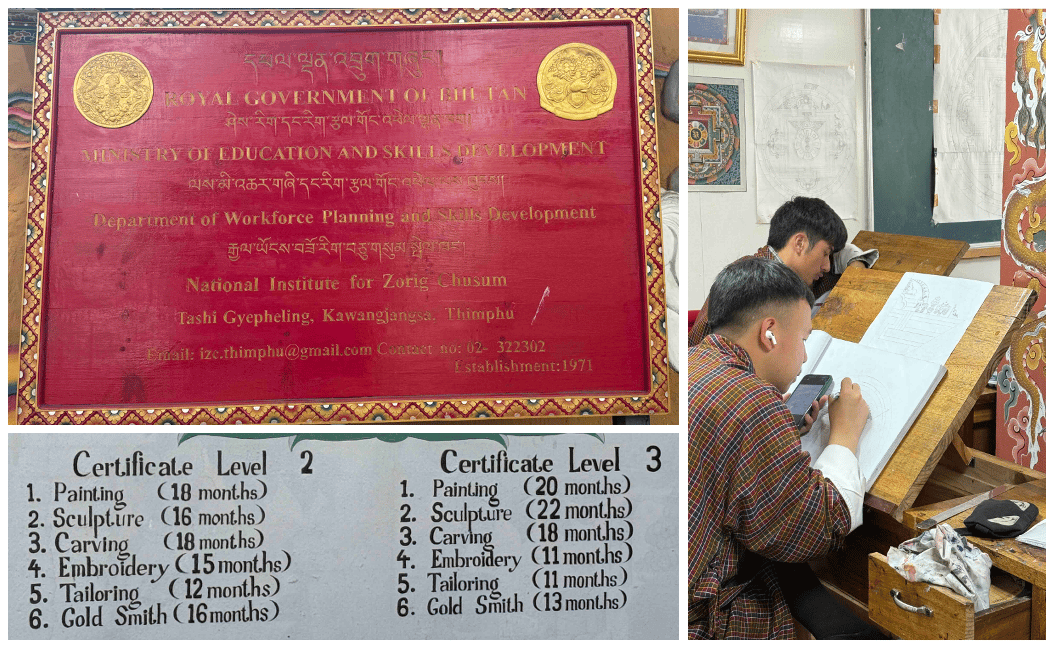
I visited the Ministry of Education and Skills Development's Department of Workforce Planning and Skills Development (red sign). The place was silent with students very focused, taking end of term exams. The government invests in skills development. The list shows only craft skills but Information and Computer Technology (ICT) is also taught there.
Human-centric Leadership Audit

News & Muse

📹 Fostering Creativity in the Workplace, Ed Catmull - what is creative?
🗞️ Influence Model - McKinsey's Change Management Model
📘 Humanocracry, Gary Hamel and Michele Zanini.
🎶 Brave, Sara Bareilles - showing up with intention takes courage.
With 2026 in sight, remember your behaviour sets the tone. When you visibly learn AI, show your words translate into actions, and model sustainable, human-centric work habits, your teams' trust in you increases and they gain the confidence and capacity to adapt. Modelling what matters isn’t symbolic — it’s how transformation becomes real and how your organisation builds momentum for the future.
Benefit from my decade of attention to the Future of Work, engaging leaders to address essential shifts and show their teams how to adapt effectively in the flow of work. Click here to book a 45-minute session.
Until next time!
Sophie
Scalable strategies. Tactical talk. Workforce transformation.
Human-centric workforce innovation in the age of AI
workforce and scale your business, navigating the fast-paced
unpredictable marketplace.