
Make Millennial Leadership Meaningful


2025 has been turbulent. Reactivity - not strategic activity - reigned. In 2026, we need to be responsive and proactive, even as change stays constant. How? By now, we have absorbed evolutionary dynamics and identified key issues. We better understand work in motion. Mid-year, Millennials became the dominant leadership group. With a different contextual lens, Gen Yers' interpretations of 2025's experiences provide updated approaches to advance with intention.
“Passion for purpose will follow millennials as they move into leadership roles, and good leadership might look more like inspiring others to work towards a shared goal instead of relying solely on the motivational potential of promotions and perks." — Tharawat magazine article, 2021.
What Happened in 2025?!
SLOP. That's the Economist's word for 2025, with a new definition added in the Cambridge Dictionary of "low-quality content created by AI". The word can also describe the inconsistent, tactical ways AI-driven changes were often handled.
Understandable but not constructive. We've been dealing with broken supply chains, volatile costs, hesitant markets, and anxious workers. We're trying to navigate uncertainties with increasingly powerful tools. Where to use them? To do what to generate new business - finding and better serving new customers?
Without recrimination and 'we-coulda-woulda-shoulda' retrospectives, draw out meaningful reflections from your entire workforce. Diversity of experiences between roles, levels, and disciplines can surface the full range of perspectives.
This information is critical to determine what decisions and actions worked in what situations, what didn't, and why, considering the significant challenges navigated during 2025, including:
- Tariff Turbulence: Policy impacts have included hesitant workforce planning, reduced IT spending - IDC's 2025 forecast of growth dropped from 10% to 5% due to tariffs [CIO.com]. Businesses postponed capital investments, rerouted supply chains, and managed export restrictions.
- AI Implementation: Only 6% of AI projects delivered returns within 12 months, 47% of enterprise AI users made at least one major decision based on hallucinated content in 2024. 70-85% of AI initiatives failed to meet expected outcomes. 42% of companies abandoned most AI initiatives in 2025 (up from 17% 2024) - cost overruns being the primary reason [fullview, AI Statistics & Trends for 2025, updated Nov 28, 2025].
- Competitive Intensity: Increasing competition was the cited as the fifth biggest global risk in 2025 - from geopolitical tensions, technology disruptions, and talent scarcity - which is expected to rise to the third biggest risk by 2028 [AON, 2025 Global Risk Management Survey].
- Strategic Planning: Only 22% of organisations take a "structured and documented approach to scenario planning" managing change, even though scenario planning would allow leaders to drive strategic objectives through change [McLean & Co, HR Trends Report for 2026].
- Intergenerational Tension: 31% of hiring managers surveyed avoid recruiting Gen Z in favour of older workers [HRdive]. 51% of managers reported frustration managing Gen Z employees. 18% considered quitting because of stress managing Gen Zers [Intelligent.com].
- Employee Experience: 73% y-o-y increase in employee discussions of burnout [Glassdoor, see graph]. Managers 1.7x more likely to report high levels of workplace stress compared to non-managers [McLean & Co, 2025 Employee Engagement Trends Report].
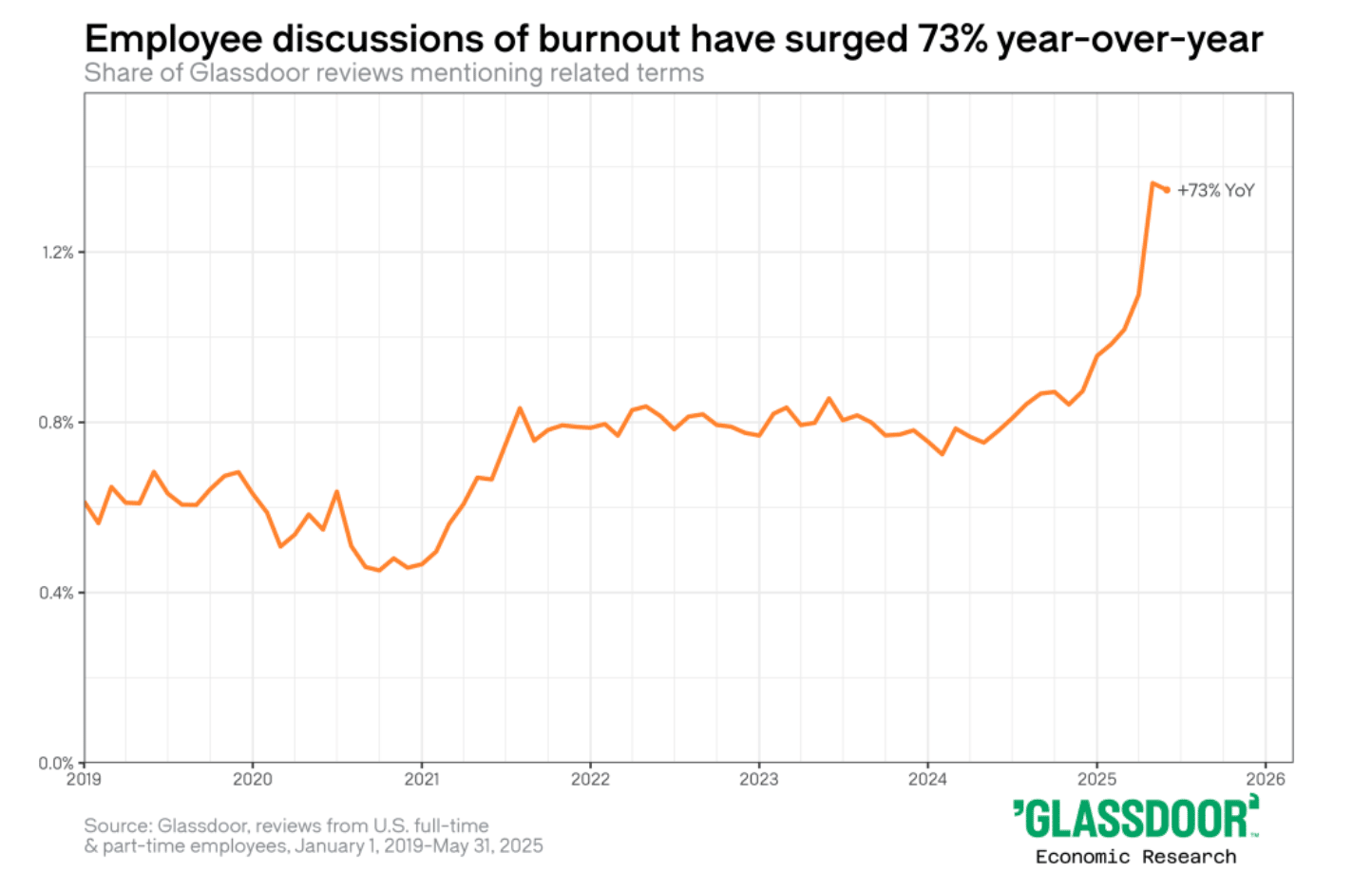
With the data, leaders can assess issues and options to test and move forward.
“We have a sense of entitlement, a sense of ownership, because, after all, this is the world we were born into, and we are responsible for it."— Evan Spiegel (35), CEO, Snapchat.
Millennial Managerial Majority
As we approach 2026, for the first time millennials are a larger share of the managerial workforce than Gen Xers, while 10-11,000 Boomers are still retiring daily [Glassdoor, Worklife Trends 2025: Midyear Check-In]. Millennial CEOs now represent >15% of the Russell 3000 (up from 13.8% in 2017) taking more roles from Boomers than Gen Xers, who now hold 43.4% of CEO roles (prev 51.1%).
Why the hand off to Millennials over Gen Xers?
- AI tool adoption: millennials 50% versus Gen X 34%.
- Median ROI on AI projects: millennials 55% versus Gen X 25%.
- Millennial-led firms show 22-32% revenue growth from AI integration, e.g. millennial CEOs at Lime (36), Kickstarter (33) embedding AI training into daily workflows, cultivating a culture of continuous learning.
- Gen X-led companies lag in AI adoption and suffer credibility gap in AI-driven sectors, impacting talent retention [ainvest article "The Shift in Leadership Power: Why Millennials are Displacing Gen X in CEO Roles" - note 'Generated by AI Agent TrendPulse FInance'.
Why does this generational leadership shift matter?
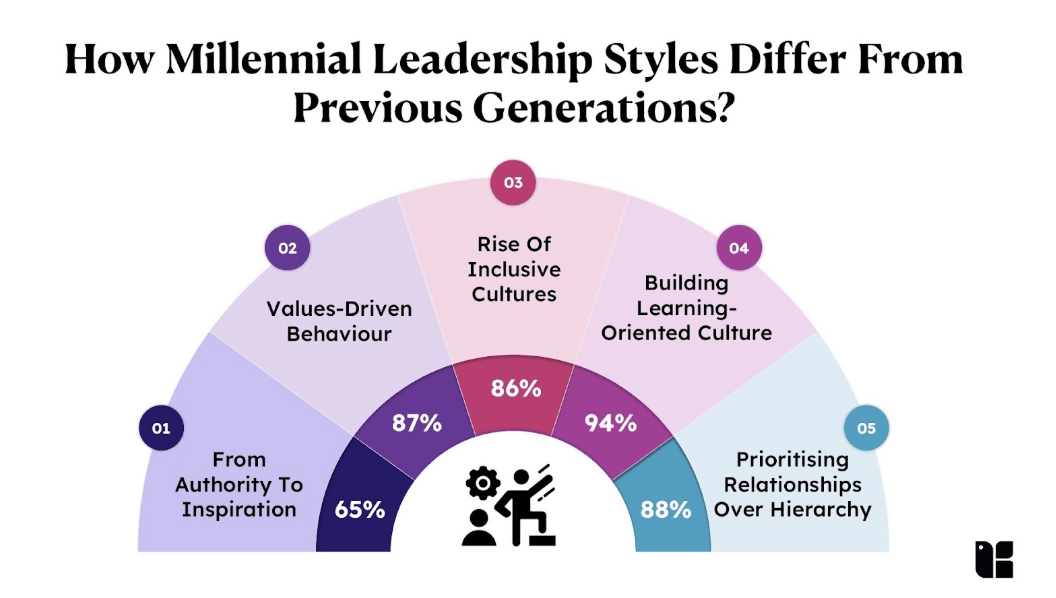
Raised with technologies and mobile capabilities (computers or smartphones in school or college), as work has become increasingly digitalised, millennials' mindsets and approaches are better suited to modern work dynamics than previous generations [Kapable, Millennial Leadership Statistics 2025]:
- 87% value continuous development - e.g. building a learning culture.
- 84% want remote work options - i.e. offering hybrid or fully remote.
- 92% say purpose is key to job satisfaction - which boosts engagement.
- 64% won't stay without long term growth - e.g. understanding how focus on career progression and talent mobility improves retention.
Advancing through prime career years while many raise young families, this group values flexibility, work/life balance, autonomy, upskilling and supports navigation of non-linear careers, well-aligned with younger Gen Z employees.
“If you want to be a CEO, the most important thing is to not let anyone make you feel like you don't belong or that you can't do anything."— Damola Adamolekun (36), CEO, Red Lobster.
Digital DNA

Human-centric workforce innovation in the age of AI
workforce and scale your business, navigating the fast-paced
unpredictable marketplace.
Generational EQ

Distributed Works

THE 2025>2026 LEADERSHIP INFLECTION POINT
Execution isn’t the bottleneck anymore. Leadership is.
As 2025 wraps up, one trend is unmistakable: the hardest challenges leaders face today aren’t operational — they are about mindset, intention, perspective, and understanding. Teams are stretched, tensions are high, expectations are rising, and decisions must be made in conditions of constant change.
With the shift to Millennial-based leadership comes a new standard, leaders who: think clearly under pressure, are prepared for dynamic situations, can interpret complexity in context, and align people without adding control.
My Leadership Advisory Sessions are designed for leaders operating at this level and those seeking to activate all their leadership strengths. We work one-on-one to build upon 2025's progress, strengthen distributed decision-making, enhance transparency and teamwork, navigate organizational dynamics, and sharpen the instincts that separate strong performers from exceptional ones.
To help you prepare for 2026, I am opening up 20-minute exploratory slots for leaders considering private advisory work at this critical juncture. From there, we can decide whether a paid 45-minute session is the right next step.
Scaling Skills-first

Activate Your Advantage
The generational shift is important to recognise to gain or sustain a competitive edge in development of strategic responses to 2025's learnings. As a millennial leader, or someone working with one or having a millennial mindset, animate millennial-lens tech-driven flexibility, human-centric understanding and modern work adaptivity to develop context-relevant intentional strategic plans for 2026.
Tariff Reactivity to Resilience:
2025 - Companies that diversified survived, those that didn't were impacted. Millennials' attitude of continuous development translates into building adaptive systems not fixed solutions.
2026 - Move from cost-cutting to capability-building in your supply chains. Model multiple scenarios for critical inputs. Establish relationships with diverse suppliers to ensure system resilience.
Technology Anxiety to Integration:
2025 - Organisations where employees experimented and implemented AI as a beneficial tool thrived, those fearing AI or seeing a threat, stalled or sabotaged.
2026 - Identify the AI champions to demonstrate its potential and range. Introduce AI training programs that focus on human-AI collaboration, emphasising soft skills (incl. empathy) alongside technical capabilities.
Intergenerational Intepretor:
2025: Stress from disconnects between age groups has affected 41% of managers. Of the 65% who altered their management style for Gen Z reports [Intelligent.com], millennials are well-equipped to adapt.
2026: Bring millennial understanding to share earlier cultural norms and current early career challenges to bridge generational gaps. Set up and facilitate bi-directional mentoring pairs. Build leadership team with generational diversity.
Employee Experience:
2025 - Non-engagement derived from lack of meaning in work, burnout resulted partly from fear and inflexible, lagging systems. Millennials prioritise purpose, empowerment and collaboration.
2026 - Connect employees to their daily work with transparent communication and shared goals. Give decision-making authority to middle managers. Formalise continuous feedback loops to replace annual surveys and connect engagement data with performance trends.
Millennials Leading with Meaning
Red Lobster CEO, Damola Adamolekun (35), rebuilt trust among employees by prioritising clarity, capability, and communication. He emphasised that private equity often overlooks the human element in hospitality and made guest experience and employee morale central to his turnaround strategy, read more.
Canva CEO, Melanie Perkins (37), plans to build one of the world's most valuable companies AND do as much good as possible. She still personally onboards all new hires, ensuring everyone understands the vision and culture. She and her partner donated most of their shares to the Canva Foundation, focusing on poverty alleviation and charitable causes, read more and more.
Revolut CEO, Nikolay Storonsky (41), takes a hands-on approach to building products. He believes the company vision needs to be something everyone wants to achieve, emphasises "Never Settle" culture and builds diverse, lean teams with a data-driven approach focused on 10x results, read more.
Airbnb CEO, Brian Chesky (43), envisions the company as helping people connect culturally worldwide, inspiring employees to see purpose in their work. During COVID, business dropped 80%, he let go 25% of workers writing them personal letters and created a $250 million relief fund for struggling hosts, more
Monzo (former) CEO Tom Blomfield (40) focused heavily on user experience, introducing features that traditional banks never considered. He stressed community engagement and transparency, actively participating in online forums and personally responding to customers. He pioneered radical transparency publishing updates on Mondo's financial performance, more.
“Hire great people first of all... get great people in your organization. So recruiting is key and then once you get them there, give them information, trust them, empower them, align them to the business and let them run." — Damola Adamolekun (36), CEO, Red Lobster.
Human-centric Leadership Audit

News & Muse

📹 Fostering Creativity in the Workplace, Ed Catmull - what is creative?
🗞️ Glassdoor Worklife Trends 2025: Midyear Check-In - intriguing insights.
📘 Millennials' Guide to Management & Leadership, Jennifer Wisdom.
🎶 We Are Young, Fun. - uplifting and energising.
Millennial leaders are redefining what leadership means. Bringing a tech-driven sensibility with human-centric emphasis, you and your leadership team must actively adjust to the new leadership zeitgeist to make 2026 a pivotal growth year. Intentionally elevate purpose, increase transparency, infuse flexibility, share decision-making, and close generational gaps.
Can your company harness all your millennial leadership intelligence and instincts fast enough? Are you ready to lead through change with clarity? I work with executives and leadership teams to translate strategy into sustainable transformation that your people can easily execute. Click here to book a 45-minute session.
Until next time!
Sophie
Scalable strategies. Tactical talk. Workforce transformation.
Human-centric workforce innovation in the age of AI
workforce and scale your business, navigating the fast-paced
unpredictable marketplace.