

Stop Building a Better Yesterday

I've presented variations of a talk about the Three Horizons model at WorkSpaces, Tradeline Space, and in client workshops. Each time, the same pattern emerges: people nod along when I describe the distant future or acknowledge today's challenges, but visibly squirm when I ask them to examine the “messy middle” transitional space where so many teams and systems are stuck.
While my talk started in real estate, the principles apply to any function navigating transformation: HR designing new performance systems, IT rolling out collaboration tools, operations reimagining service delivery.
The core insight is simple but uncomfortable: most organizations think they're building the future when they're actually just making the past slightly more tolerable.
Understanding the Three Horizons
The Three Horizons framework comes from futures and strategic foresight practices. It helps us see how systems evolve and how we might be holding ourselves back. An article by John Rousseau inspired me to adopt it.
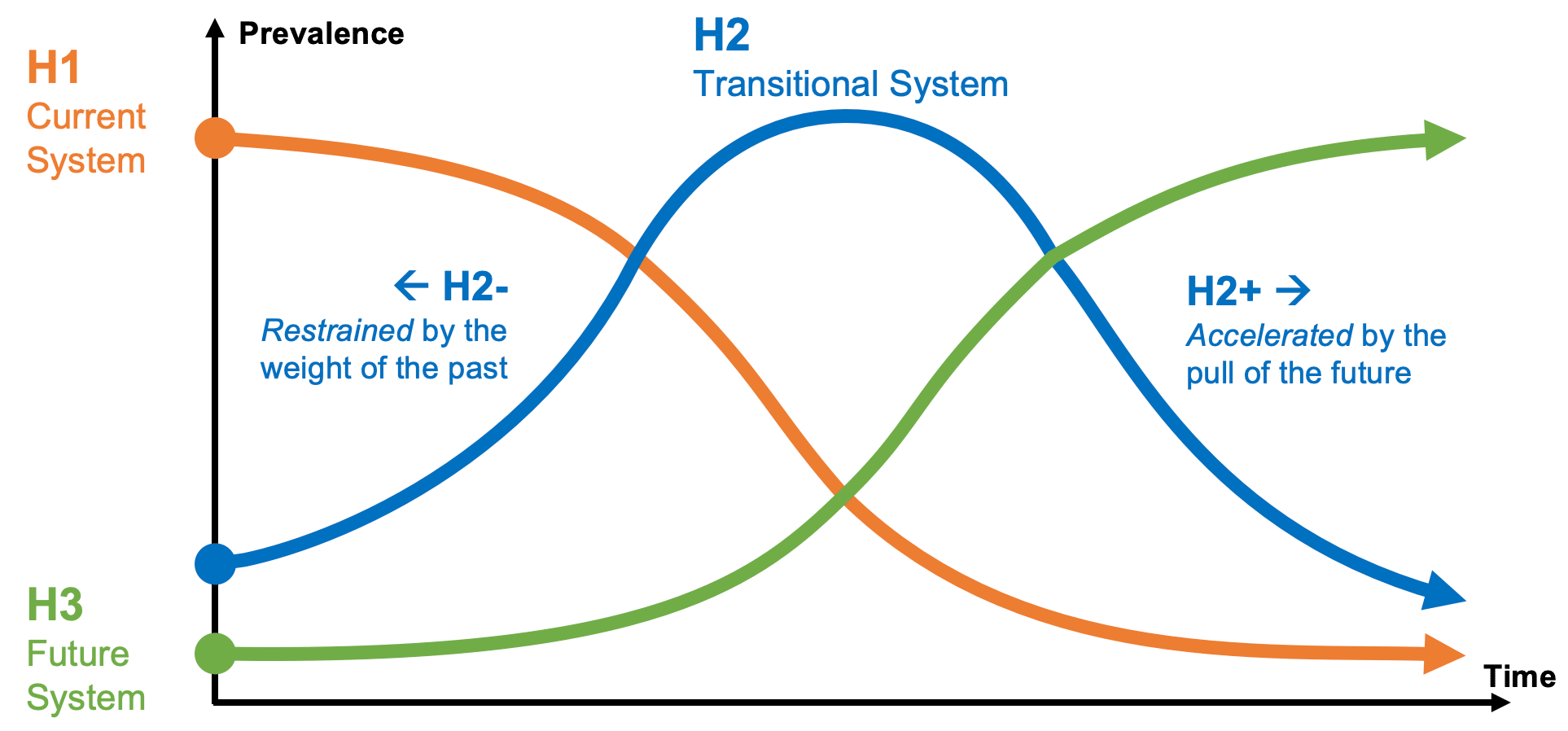
Horizon 1 (H1) represents today's dominant system: 40-hour workweeks, daily commutes, hustle culture, endless meetings, rigid org charts.
Horizon 3 (H3) represents the far future. Think flying cars, universal basic income, true AGI, complete breakdown of corporate hierarchies. We can imagine it, but it feels impossibly distant.
Horizon 2 (H2) is where things get interesting. This is the transitional system, the messy middle where innovations either revitalize the old ways or catalyze genuine transformation.
And the critical distinction is that H2 comes in two flavors.
Horizon 2 Minus (H2-) is restrained by the weight of the past. Initiatives feel like progress but are only slight modifications: hybrid work, desk booking systems, 4-day workweeks that don't reimagine work itself.
Horizon 2 Plus (H2+) is accelerated by the pull of the future: async-first work, AI-native ops, skills-based orgs, workplace-as-service models.

The uncomfortable truth? Countless teams sit comfortably in H2- territory while congratulating themselves on being innovative.
Lead Across the Lines of Modern Work with Phil Kirschner
Over 22,000 professionals follow my insights on LinkedIn.
Join them and get my best advice straight to your inbox.
Three Ways to Lean Forward
Moving from H2- to H2+ requires different thinking across functions. Here are three examples, one each for CRE, HR, and IT leaders.
RE: Define Success for Each Environment
Stop justifying offices with vague terms like "community" or "culture." Every space needs a specific, measurable purpose aligned to business outcomes. Make it deserve a chapter in your company's history book.
Here are two examples:
When Gilead renovated its Foster City campus, a corporate services exec said the purpose was "to accelerate clinical speed." Not just “collaborate”.
Melbourne Connect exists to keep smart ideas in Australia, so they have legal advice available in the community management team.

H2- thinking is assuming the building's value is self-evident.
H2+ leaders define purpose to hold your spaces accountable.
HR: Design for Capabilities, Not Hierarchy
Your CEO (or CHRO at least) is already thinking about skills-based organizations. The question is whether you're helping design them or defending the traditional org chart.
H2- is taking your current structure and adding "skill tags" to people's profiles. H2+ starts with the capabilities needed to execute strategy, and assembles fluid teams around those needs, beyond title or tenure.
This means rethinking performance reviews (continuous feedback vs. annual ratings), hiring (assessing skills vs. credentials), and career paths (horizontal growth vs. vertical climbing).
H2- organizations reorganize every 18 months.
H2+ organizations can reconfigure teams every 18 days.
IT: Treat Workplace Tools Like Products With Users
Every SaaS company has customer success teams whose job is ensuring clients actually use what they bought. Yet when IT rolls out Slack, Teams, or any workplace tool, the approach is often: "Here's the login, good luck."
H2- assumes adoption happens automatically.
H2+ knows workplace requires the same customer success mindset as external products.
This means:
- Defining clearly how each tool should be used
- Educating users beyond feature demos to teach work behaviors
- Creating internal champions who model best practices visibly
- Measuring adoption and intervening when tools aren't delivering
H2- IT leaders ask "Are people using the new tool?"
H2+ leaders ask "Are people working differently?"
🚨 Invite-Only AI Change Forum 🚨Mapping Resistance and Momentum Together
Together with Daan van Rossum from Lead with AI, I’m hosting an invite-only AI Change Forum for just 20 leaders who are shaping AI adoption inside their organizations.
We'll use my Four Force framework to explore where resistance and momentum live, and use peer discussions to exchange best practices and lessons learned.
📅 Nov 18th @ 8am PST | 11am EST | 4pm GMT | 5pm CET
If this feels relevant to your work, and you have a story or challenge worth unpacking

How to Recognize H2- Thinking
Before moving to H2+, you must know when you're trapped in H2-.
Here's a simple diagnostic. Ask yourself:
Is this solution primarily designed to preserve what we had before, or to enable what we need next?
Other warning signs of H2- thinking:
- Justifying decisions with "we've always done it this way"
- Making minor tweaks instead of questioning core assumptions
- Treating flexibility or change as a concession to be minimized
- Focusing on current system efficiency vs. new system effectiveness
- Measuring success by how little disruption you cause
If your "transformation" could be easily reversed with minimal resistance, it's probably H2-. Real H2+ initiatives feel risky precisely because they fundamentally alter how work happens.
Your 90-Minute Workshop
The best way to move from H2- to H2+ is to make the horizons visible. Gather your team for a 90-minute working session:
- Map H1 (30 min): Be brutally honest about how work actually happens today. Not the aspirational policy—the lived reality.
- Envision H3 (20 min): Dream big. What would your function look like in 2040 if everything went right?
- Identify H2 Initiatives (20 min): List every "change" project currently underway. Which are H2- (preserving the past) and which are H2+ (enabling the future)?
- Experiment in H2+ (20 min): Pick one initiative you could test in the next 60 days that genuinely leans forward. It doesn't need to be big or expensive; it needs to be brave.
Document your work. Share it with stakeholders. Establish a “North Star” vision. Revisit it quarterly as your horizons evolve.
Who's Writing Your Future?
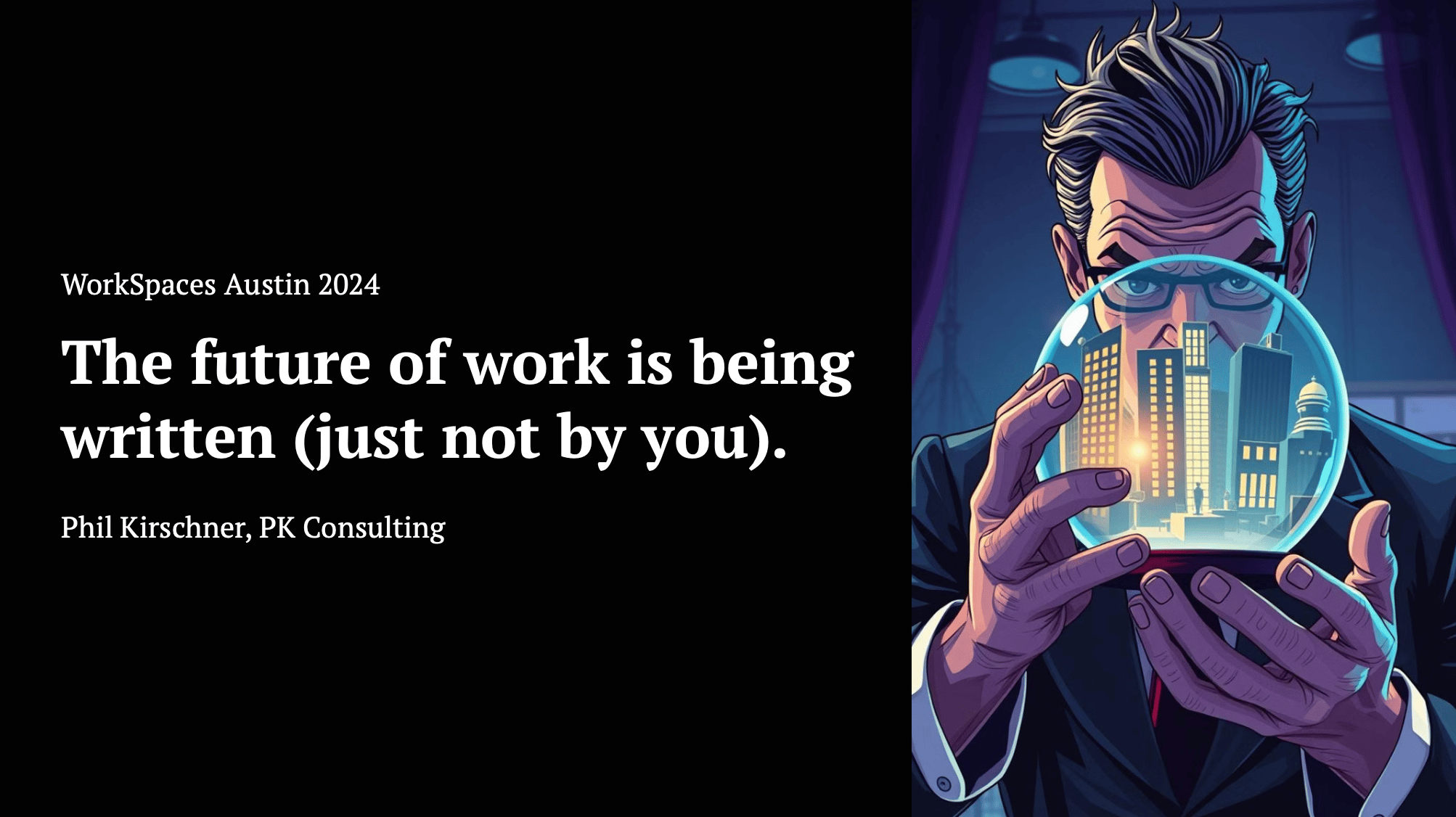
As I told the audience at WorkSpaces last year, your CEO has a vision for the future of work, and it likely came from a consultant like me or a book they read on a plane. The question is whether the people who actually execute on workplace, talent, and technology are part of writing that future or just implementing someone else's version of it.
The organizations that thrive won't be the ones with the best real estate, the most sophisticated HR tech, or the fastest deployment of AI tools. They'll be the ones where leaders across functions recognize H2- thinking, and have the courage to push toward H2+ instead.
The future of work is being written. The only question is whether you're holding the pen or just reading along.

Which of these patterns resonates most with your organization? What are you seeing in your corner of the messy middle?
Lead Across the Lines of Modern Work with Phil Kirschner
Over 22,000 professionals follow my insights on LinkedIn.
Join them and get my best advice straight to your inbox.