

Work-life balance is one of the most searched phrases in the modern professional vocabulary. It is also one of the most misunderstood.
Most definitions make it sound like a perfect split: work on one side, life on the other, each getting exactly what it deserves.
But the research tells a different story. According to Greenhaus, Allen and Spector (2006), work-life balance is the degree to which an individual's effectiveness and satisfaction in the roles of work and family are well-matched with their life priorities:
Work life balance is the degree to which an individual's effectiveness and satisfaction in the roles of work and family domain are well-matched with the individual's life priorities. - Greenhaus, Allen and Spector (2006)
Notice what that definition does not say: it says nothing about equal hours, perfect separation, or doing it all at once.
The question is not how to divide your time more evenly. It is how to build a working life that is actually worth living, where the work means something, where your energy is spent on what matters, and where you, as a leader, are grounded enough to create that for the people around you.
The 50 quotes below are drawn from researchers, philosophers, CEOs, psychologists, and artists.
Some are challenging. Some are uncomfortable. All of them push back against the shallow version of the conversation.
Read them alongside our deeper explorations of happiness at work and human flourishing at work, because balance, at its best, is a symptom of flourishing, not a substitute for it.
Quotes on What C-Suite Leaders Have Learned About Work Life Balance
The people at the top often learn about balance the hard way. These quotes reflect hard-won perspective from those who have lived it.
1. Evan Williams, Former Cofounder and CEO of Twitter
There is no productivity argument that defeats this one. The body keeps score:

2. Mark Zuckerberg, CEO of Meta
One of the most underrated truths about deep work: it rarely looks like work from the outside:

3. Marissa Mayer, Former President and CEO of Yahoo
This is a prioritization argument disguised as a resignation. The second half is the important part:

4. Sheryl Sandberg, Former COO of Meta Platforms
The framing is the problem. Work is not the opposite of life. It is part of it:

5. Marc Benioff, Chairman and CEO of Salesforce
The leader's beliefs about balance become the culture's beliefs about balance:

6. Velera Wilson, Founder and CEO of Positive Identity

7. Evan Williams
One of the starkest reminders on this list. The company can be rebuilt. Some things cannot.

From Researchers and Thinkers on Work and Meaning
8. Arthur C. Brooks, on what the work actually requires
Nothing on this list carries more weight for senior leaders. The people below you do not need your hours. They need your groundedness.
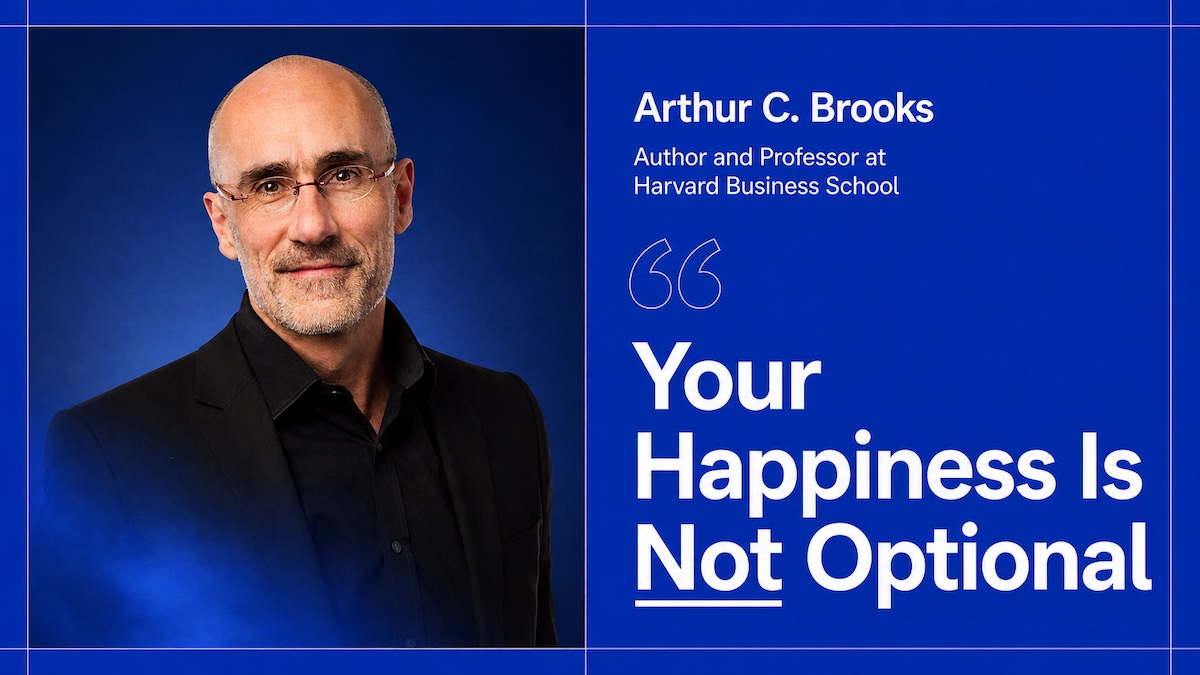
9. Arthur C. Brooks, Harvard professor and bestselling author
"Happiness is not a state you arrive at. It is a direction you move in."
This reframe undoes most of the damage done by achievement culture. You are not behind. You are moving, or you are not. Read the full case Brooks makes in our conversation on why a leader's happiness is their most important professional responsibility.
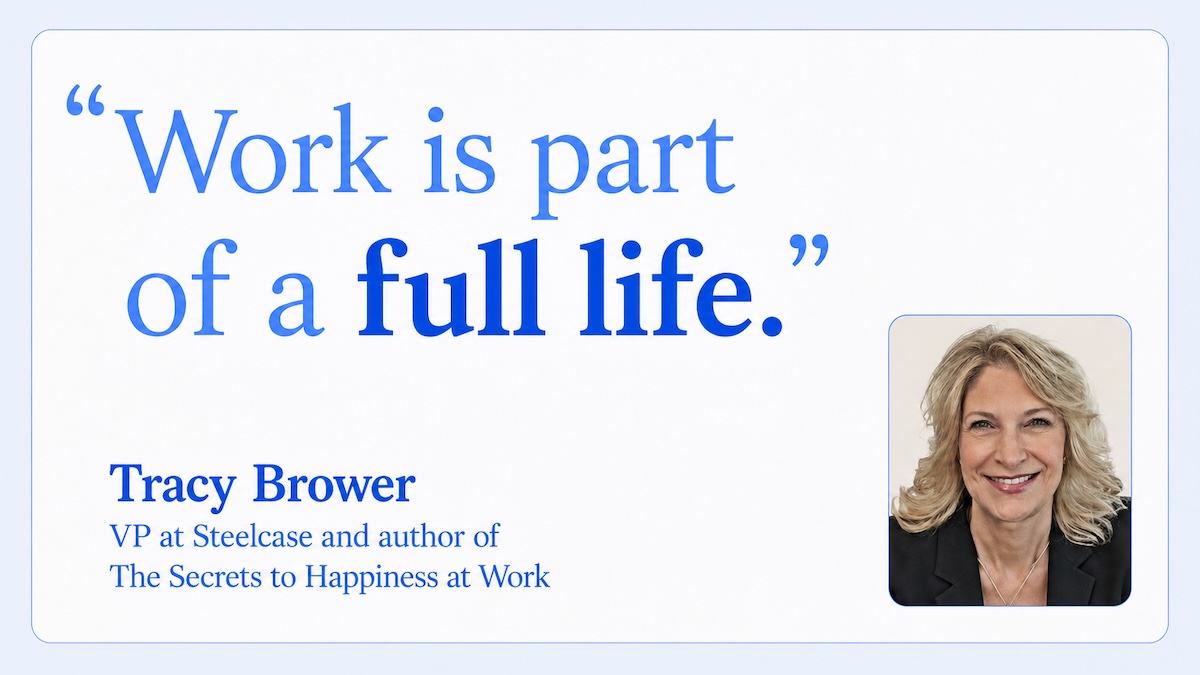
10. Tracy Brower, VP at Steelcase and author of The Secrets to Happiness at Work
Four words that reframe the entire conversation. Not work versus life. Work as life. Brower's full thinking on what drives happiness at work is worth exploring beyond this quote:
11. Martin Seligman, father of positive psychology and creator of the PERMA model
"These machines can help you with the emotional part of your life."
Said about AI, and one of the more surprising arguments for why the hours AI gives back matter. At 83, Seligman used Claude to write illustrated stories for his grandchildren and said it brought more love into his life. The full argument is in our conversation on AI, human agency, and what makes us irreplaceable.
12. Dave Ulrich, HR expert and author
The bundling insight is underused. Integration often serves better than separation:

13. Tracy Brower, HR Expert and Author, The Secrets to Happiness at Work
The perfectionism is itself the problem. Balance is a season, not a daily target.

The Philosophers, Classicists, and Stoics
The oldest thinking on this topic is often the sharpest. These voices were grappling with the same questions — before productivity apps existed to distract from them.
14. Seneca
"It is not that we have so little time but that we lose so much."
From On the Shortness of Life, written around 49 AD. Nothing has changed.
15. Epictetus
"No man is free who is not master of himself."
Agency over your attention and your schedule begins here. Everything else follows.
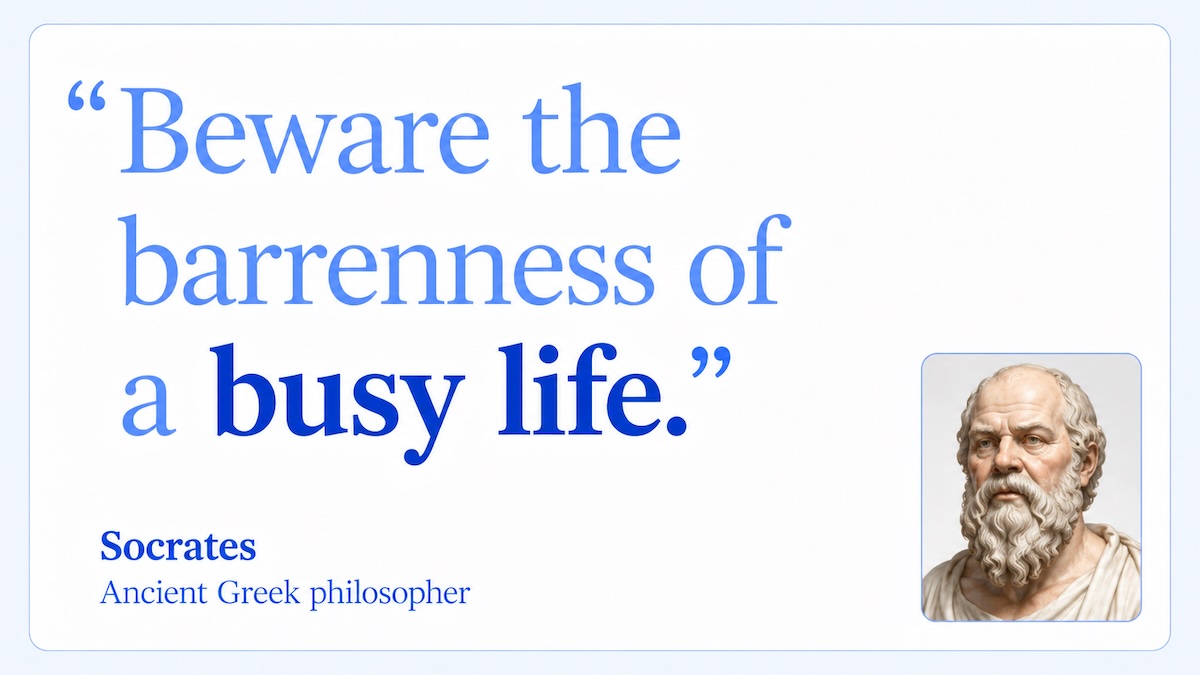
16. Socrates
The warning that productivity culture was not listening to in ancient Athens, and is still not listening to now.
17. Aristotle
"Pleasure in the job puts perfection in the work."
Flourishing was always the point. The Greeks called it eudaimonia. We call it engagement. The concept predates every Gallup survey by two millennia.
18. Gustave Flaubert
"Be steady and well-ordered in your life so that you can be fierce and original in your work."
This is the productive argument for balance: the creative and strategic work requires a stable life as its foundation. Chaos in one bleeds into the other.
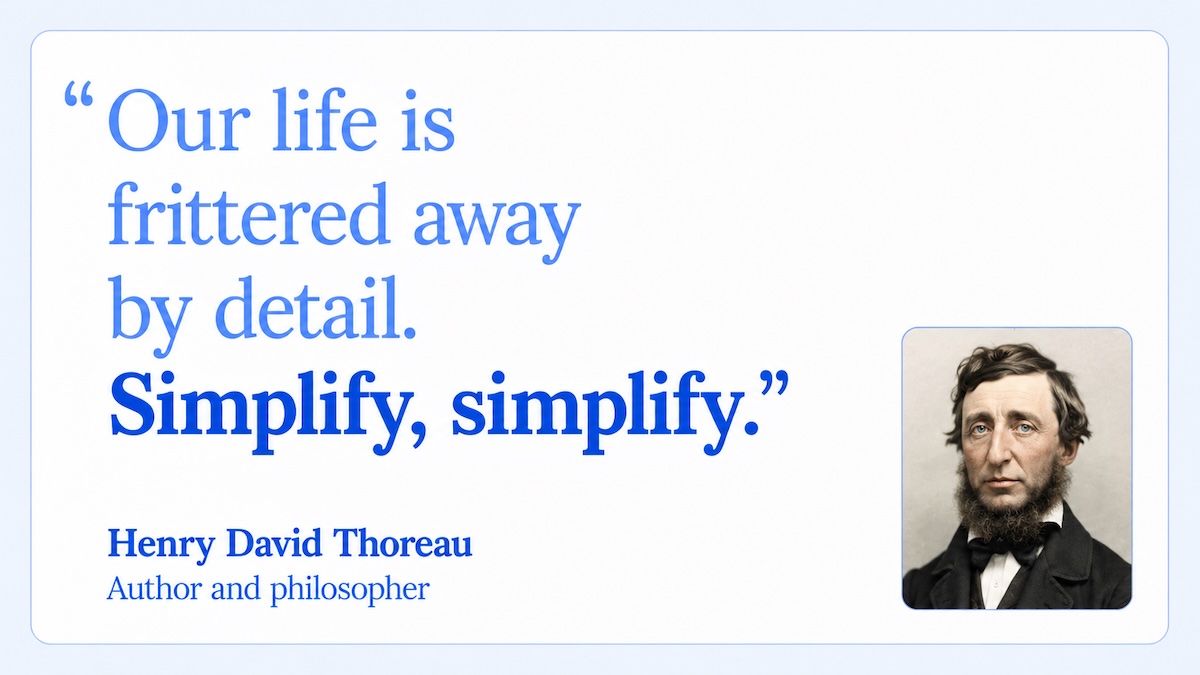
19. Henry David Thoreau
"Our life is frittered away by detail. Simplify, simplify."
From Walden. Written in a cabin by a pond, but applies perfectly to your inbox.
20. Henry David Thoreau, on the question behind the busyness
The hours saved by AI mean nothing if they are immediately filled with more of the same. This is the question FlexOS exists to help leaders ask.
21. Thich Nhat Hanh
"The present moment is the only moment available to us, and it is the door to all moments."
Presence is the first thing busyness destroys and the first thing balance restores. See also: our collection of mindfulness quotes for work.
Why Balance Matters: The Human Case
Some quotes need no framework. They just land.
22. Heather Schuck, author of The Working Mom Manifesto
The sequence matters. Life satisfaction is not the reward for career success. It is a prerequisite for it.

23. Harold Kushner, rabbi and author
Possibly the most repeated line in this genre. It keeps getting repeated because it keeps being true.

24. Marilyn Monroe
Blunt, warm, and more philosophically honest than most business books.
.avif)
25. Sydney J. Harris, journalist
The integration that Ulrich describes above, Harris captures in literary form. The boundary is always more porous than we pretend.

26. Sydney J. Harris, on regret
The asymmetry of regret is well documented in behavioral science. Harris named it long before the research confirmed it.

27. Ralph Waldo Emerson
"The purpose of life is not to be happy. It is to be useful, to be honorable, to be compassionate, to have it make some difference that you have lived."
Meaning, not just pleasure. The distinction runs through everything we know about what makes work worth doing at all.
28. Friedrich Nietzsche
"He who has a why to live can bear almost any how."
Viktor Frankl quoted this in Man's Search for Meaning and built a therapeutic framework from it. Purpose is the deepest form of resilience.
Practical Wisdom: What to Actually Do
Inspiration without direction becomes wallpaper. These quotes move toward action.
29. Michelle Obama, former First Lady
Said in the context of women's health, but the principle holds universally. You cannot give from empty.

30. Stephen Covey, author of The 7 Habits of Highly Effective People
The "non-apologetically" is doing the most work in that sentence. The boundaries we apologize for are the ones we abandon.

31. Charles Buxton, former Member of Parliament
Agency is not found. It is exercised. This is as true for a calendar as for a career.

32. Katie Thurmes, Co-founder of Artifact Uprising
The counterintuitive productivity argument. Depth of attention requires breadth of life.

33. Caterina Fake, Co-founder of Flickr
The hours question and the direction question are separate questions. Most organizations only ask the first one.

34. Anne Lamott
"Almost everything will work again if you unplug it for a few minutes — including you."
The simplest case for rest on this list, and possibly the most persuasive.
35. Carl Sandburg
"Time is the coin of your life. It is the only coin you have, and only you can determine how it will be spent."
Spend it with care. Delegation is one way. Clarity on what matters is the prerequisite.
On Misconceptions About Balance
Some of the most useful quotes challenge the premise of the conversation itself.
36. Arianna Huffington, founder of Thrive Global
Hours as a proxy for performance is one of the most expensive mistakes in organizational life.

37. Andrew Wilkinson, founder of Tiny
The suffering narrative is a cultural artifact, not a factual requirement.

38. Oprah Winfrey
Sequence is a form of balance. Not everything belongs in the same season.

39. Hillary Clinton
The confusion is extraordinarily common. The career can be a vehicle for a full life. It cannot be the whole destination.

40. Nassim Nicholas Taleb
"The three most harmful addictions are heroin, carbohydrates, and a monthly salary."
The most provocative entry on this list. What Taleb is pointing at: the false security of a fixed income can be the thing that keeps people in work that has stopped making sense.
On Identity, Presence, and the Self Beneath the Role
The deepest work-life balance questions are not scheduling questions. They are identity questions. Who are you when the job description changes? What remains?
41. Kurt Vonnegut
"We are not human doings. We are human beings."
The most succinct case for identity beyond output. Worth reading slowly.
42. Dolly Parton
Simple enough to dismiss. True enough to sting.

43. Mother Teresa
The leader who cannot be present at home will not be present in the meeting either. The relational quality travels.

44. Hans Hofmann
"The ability to simplify means to eliminate the unnecessary so that the necessary may speak."
Attention is finite. Simplification is not minimalism. It is clarity about what actually matters.
45. Celine Dion
The hedonic treadmill has a career version. More achievement, higher baseline, same gap. Understanding this is the beginning of a different relationship with ambition.

46. John Lubbock
"Rest is not idleness, and to lie sometimes on the grass under trees on a summer's day, listening to the murmur of the water or watching the clouds float across the sky, is by no means a waste of time."
Written in 1894. The guilt around rest is not new. Neither is the case against it.
47. Epictetus (again)
"No man is free who is not master of himself."
Freedom is not the absence of work. It is the presence of self-direction. Agency is the thing worth protecting.
On the AI Question: The Hours Being Given Back
The conversation about work-life balance has a new dimension. AI is returning hours to knowledge workers at scale. The question FlexOS keeps returning to is not how to use those hours more productively. It is what to do with them that actually matters.
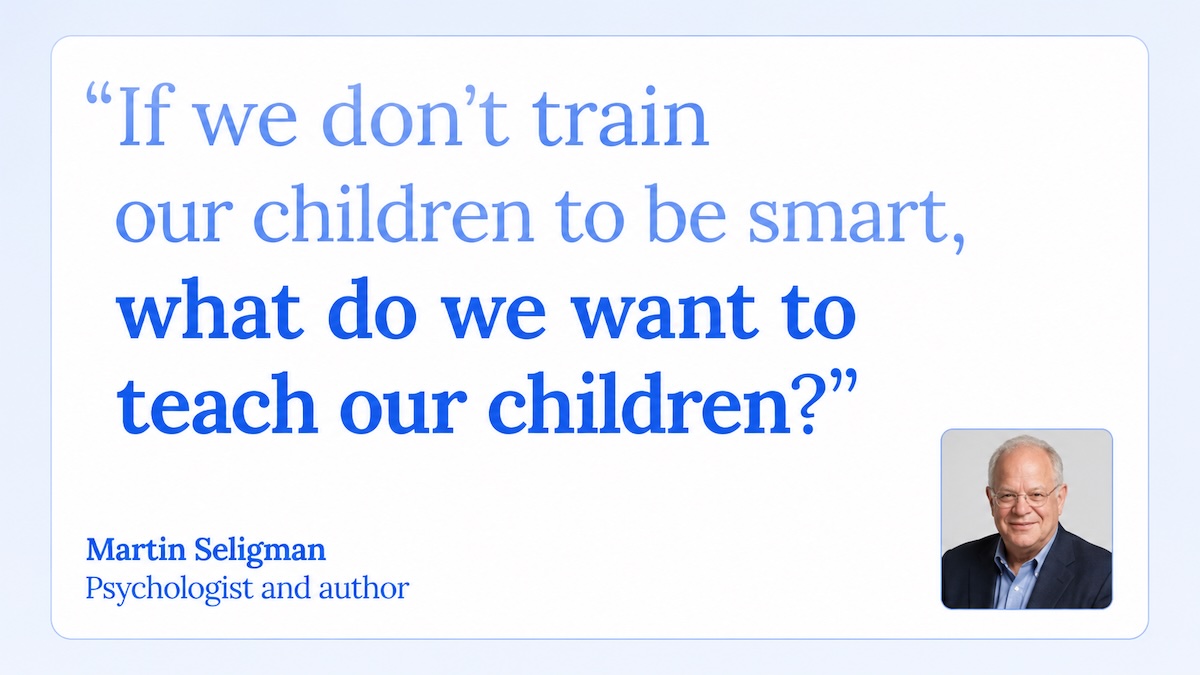
48. Martin Seligman
Asked in the context of AI leveling the cognitive playing field. His answer: positive character. How to be a good teammate. What it means to flourish. The same question applies to how we redesign work now that the machines are handling the cognitive commodity tasks. Read the full argument in our piece on Seligman on AI and human agency.
49. Kahlil Gibran
"Work is love made visible."
If AI does the tasks that do not require love, the question becomes: what do you want to make visible with what remains?
50. Arthur C. Brooks
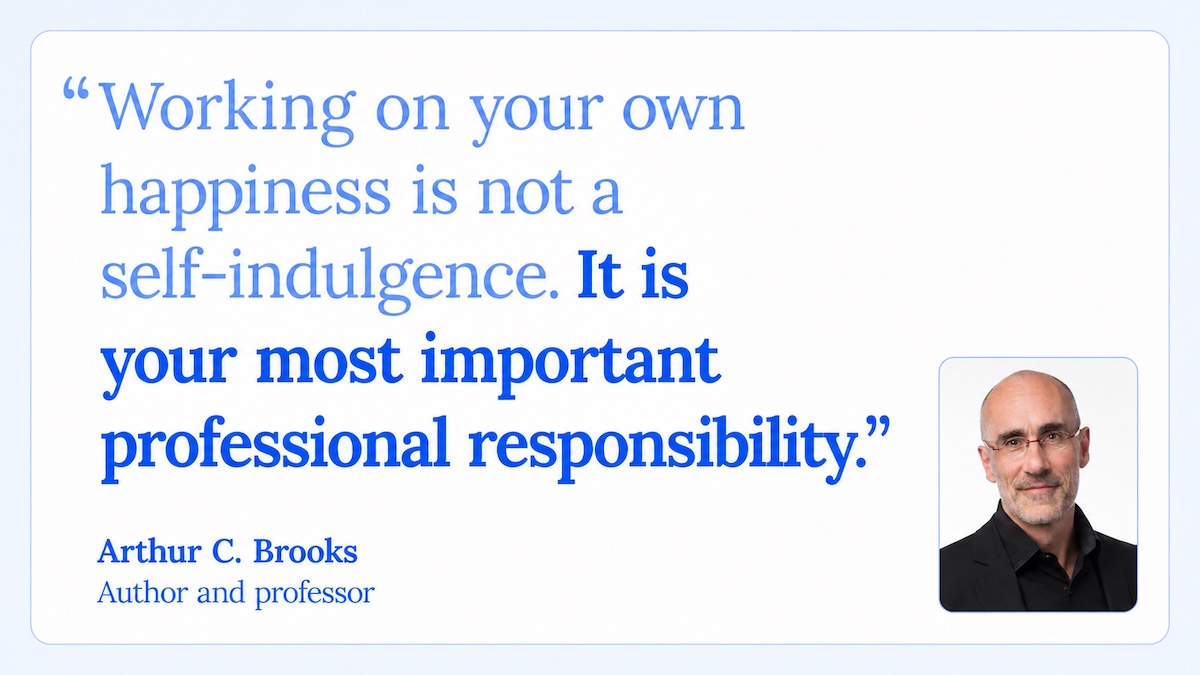
"Working on your own happiness is not a self-indulgence. It is your most important professional responsibility."
The hardest reframe in this collection. It removes the excuse that taking your own flourishing seriously is somehow a distraction from the real work. It is the real work. Everything else flows from that.
Frequently Asked Questions About Work-Life Balance
What is the best definition of work-life balance?
The most research-grounded definition comes from Greenhaus, Allen and Spector (2006): work-life balance is the degree to which an individual's effectiveness and satisfaction in work and family roles are well-matched with their life priorities. This shifts the conversation from time allocation to alignment — whether how you actually spend your time matches what you say matters most.
Why do high performers often struggle with work-life balance?
Several forces work against them. Achievement becomes a substitute for meaning. The brain's reward systems are wired for the next target, not for presence. And as Arthur C. Brooks has shown, the emotional reality of reaching the top — loneliness, anxiety, and the pressure to keep performing — is rarely what people anticipated. Understanding happiness at work is the starting point for changing that pattern.
Is work-life balance the same as work-life integration?
Not quite. Balance implies separation — two sides of a scale. Integration acknowledges that work and life are not cleanly divided, and that the goal is coherence rather than equal partition. Tracy Brower's observation that "work is part of a full life" captures the integration view. The two approaches suit different personalities and different life stages.
What does work-life balance mean for leaders specifically?
For leaders, the stakes are higher. Research cited by Arthur C. Brooks shows that the number one predictor of CEO failure is not liking the job of CEO. And the number one predictor of being a bad boss is being an unhappy one. A leader's emotional state spreads through the team, for better and for worse. This is why working on your own human flourishing at work is a leadership responsibility, not a personal luxury.
How does mindfulness connect to work-life balance?
Mindfulness addresses the quality of presence, not just the quantity of time. You can be physically at home and mentally in the last meeting. Thich Nhat Hanh's observation that "the present moment is the door to all moments" points at something practical: most of what we call work-life imbalance is actually a presence problem. Our collection of mindfulness quotes for work explores this further.
What is the role of AI in work-life balance going forward?
AI is returning hours to knowledge workers. But as FlexOS keeps asking: returned to what? The risk is filling reclaimed time with more of the same tasks, at higher volume. The opportunity is using those hours for the things that actually drive meaning, connection, and long-term satisfaction — the things that machines cannot replicate and that human flourishing depends on.
Work Life Balance Statistics You Should Know
Statistics have repeatedly shown that one of the most effective ways to achieve work life balance is by adopting hybrid or remote working models. A survey by FlexOS found that 53% of managers reported improved work life balance for their employees when given the option to work in hybrid or remote teams. (We have work from home quotes for you, too.)
A Ford research study found that 52% of employees worldwide are willing to reduce 20% of their paychecks for a better work life balance. 77% of surveyed employees said they “prioritize a balanced personal life over advancement at work.”
Coincidentally, 77% of employees experienced burnout at least once in their current job, according to a Deloitte study about workplace burnout.
Another Canadian survey showed that to most employees (84%), having a good work life balance is more important than climbing the corporate ladder, which is aligned with data from another research from The Muse in 2023, which found that 83% of survey participants said they would accept a lower-paying job if it offered a better work life balance.
Additionally, 56% of respondents value work life balance so highly that no salary increase would make them sacrifice it.
The Importance of Hybrid and Remote Work Options in Maintaining Work-Life Balance
The latest data from a Randstad study in 2023 also found 94% of respondents believed work life balance is important, and 61% of employees would not accept a job if it disrupted their work life balance.

Meanwhile, a FlexJobs survey from 2022 found that 84% of respondents said having a remote or hybrid job would make them a happier person. A 2020 FlexJobs survey on work life balance also found that having a flexible work schedule helps employees improve their work life balance while reducing their stress levels.
Finally, a new study from Gallup (from May 2024) showed hybrid employees feel most connected to their organization’s mission or purpose, while fully in-office employees think the least.

The Bottom Line
Maintaining a work life balance is not just about time management; it’s also about how you align your work and your life’s priorities daily.
With the fact that Australia has become the latest country to give employees the right to disconnect after work hours, all these statistics tell us one thing:
Work-life balance has shifted from a buzzword to a fundamental necessity.
These quotes, however, are not just insights and inspiration. They are a call to action for you to take control and find your own balance or to help others find theirs. By doing so, you can contribute to greater happiness, productivity, and overall well-being in your workplace.
Also available on:


Your Friday Briefing on the
Future of Work
Future Work delivers research-backed insights, expert takes, and practical prompts—helping you and your team capture what matters, build critical skills, and grow into a future-ready force.
Get all-in-one coverage of AI, leadership, middle management, upskilling, DEI, geopolitics, and more.
Unsubscribe anytime. No spam guaranteed.

Stay Ahead in the Future of Work
Get AI-powered tips and tools in your inbox to work smarter, not harder.
Get the insider scoop to increase productivity, streamline workflows, and stay ahead of trends shaping the future of work.
Unsubscribe anytime. No spam guaranteed.

Stay Ahead in the Future of Work
Leading in the future of work is a breeze with FlexOS. Subscribe to our newsletters and stay ahead on AI, Remote Work, and Modern Management.
We curate the most current research, news, trends, and tools to let you work smarter, not harder.
Your Friday Briefing on the
Future of Work
Future Work delivers research-backed insights, expert takes, and practical prompts—helping you and your team capture what matters, build critical skills, and grow into a future-ready force.
Get all-in-one coverage of AI, leadership, middle management, upskilling, DEI, geopolitics, and more.
Unsubscribe anytime. No spam guaranteed.
Stay Ahead in the Future of Work
Get AI-powered tips and tools in your inbox to work smarter, not harder.
Get the insider scoop to increase productivity, streamline workflows, and stay ahead of trends shaping the future of work.
Unsubscribe anytime. No spam guaranteed.
Stay Ahead in the Future of Work
Leading in the future of work is a breeze with FlexOS. Subscribe to our newsletters and stay ahead on AI, Remote Work, and Modern Management.
We curate the most current research, news, trends, and tools to let you work smarter, not harder.



.webp)

![[Research Report] Rethinking the Workweek: The Push for Fewer Work Hours, More Life](https://cdn.prod.website-files.com/6442419dcf656a81da76b503/67f62ad0c3f263946ab76bf6_67eb9ea7f1a4e15aa02357f9_67dbcc5cd852e0468b7c1ab5_67d9294873eb0f3d06db0522_67d3e3773b52fb1458bbeca9_67cfeef562a442c6b5cac417_67ce9d783f83a316431e99fb_67c805f1e959c187503b6f9a_67c6b466f85f6718abc84402_67c562f18bb2e90006fefb91_67c01ccf46d56e67e92b4a6c_67becb6ce25a88249e237189_67b590c86adb9081bf7caffb_67a31bbd70980f65543d6140_6790a675ad20d4456fda7112_678f83dd8d45ccd6bdcc0504_Rethinking-the-workweek.avif)


![[Report] The Top 100 AI for Work – March 2024](https://cdn.prod.website-files.com/6442419dcf656a81da76b503/670defe3518d73b50509fa03_6708cccc5300ba0a7c209e41_news-top-100-ai-for-work-march-2024.avif)