
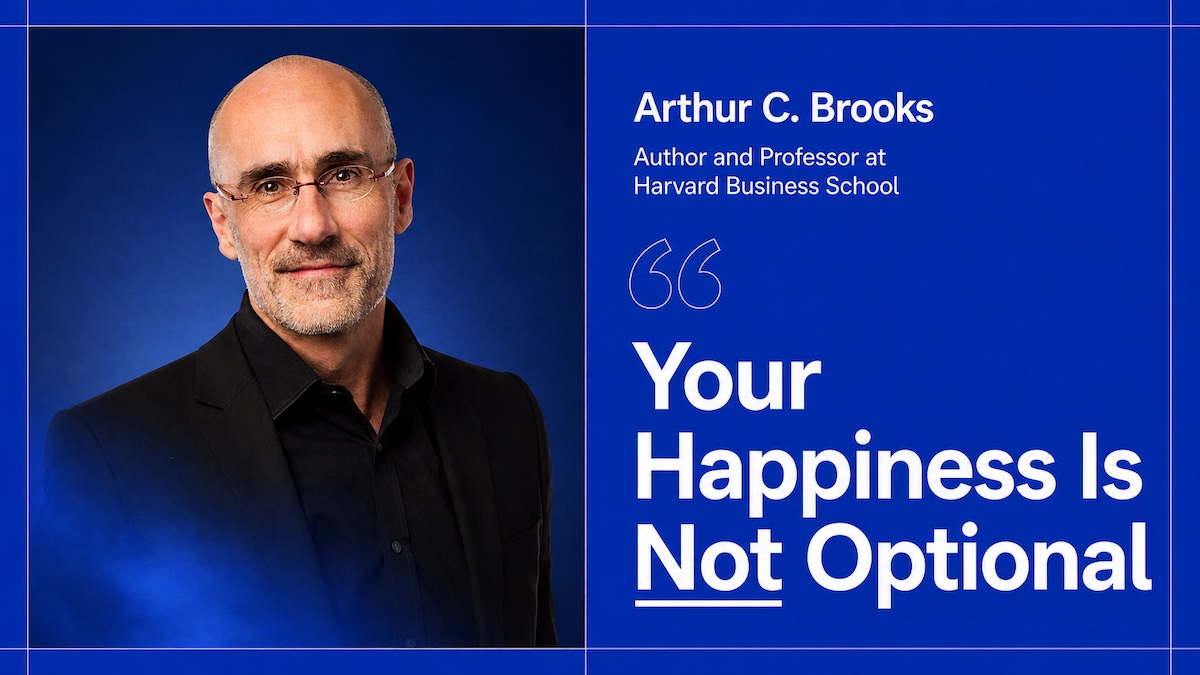

The number one and number two emotions a new CEO feels in their first 24 months on the job are not pride and excitement.
They are loneliness and anger.
That finding, from Harvard Business School professor Arthur C. Brooks, should stop all of us in our tracks. I know it did for me. We spend years climbing toward the roles we believe will finally make us feel fulfilled. Then we get there, and the emotional reality is almost the opposite of what we imagined.
Brooks has studied the science of happiness for decades. His conclusion is uncomfortable and, once you sit with it, undeniable: working on your own happiness is not a self-indulgence. It is your most important professional responsibility.
The CEO Happiness Problem Nobody Talks About
There is a reason so many people in senior roles seem brittle, reactive, or strangely joyless despite their obvious success.
Brooks points to a structural trap. Our ancient limbic system, the part of the brain built for survival not flourishing, tells us that achievement will bring happiness. Climb higher. Accumulate more. And then, at last, the feeling will come.
It doesn't come.
The number one predictor of CEO failure, shared Brooks for a live taping of HBR's "IdeaCast", is not liking the job of CEO. Not strategic missteps. Not market conditions. Not a bad board relationship. Simply not liking the actual experience of doing the work.
What does that experience actually feel like? For most, it involves an intensity of anxiety that few anticipated. Brooks defines anxiety plainly: unfocused fear. The higher you climb in an organization, the more of it you carry. Most of us were never told that was coming, and fewer still were given tools to manage it.
This isn't just a CEO problem. As Dr. Tracy Brower has found, leadership broadly is reaching a breaking point, with managers at every level choosing to step out rather than bear the emotional weight. The Gallup State of the Global Workplace 2026 report makes the same case in numbers: only 20% of employees are engaged globally, and manager engagement has collapsed faster than any other group, dropping nine points since 2022.
So we manage the anxiety badly. We become the bad boss. And the number one predictor of someone hating their job, according to Brooks, is exactly that.
The chain is direct: an unhappy person at the top produces an unhappy team. And unhappiness is contagious. Brooks calls this emotional contagion, the way one person's emotional state spreads through a family, a team, an organization, like a virus. You cannot quarantine it by willpower alone. The only real solution is to address the source.
This Is Not About Wellbeing Programs
Before we go further, let me be clear about what Brooks is not saying.
He is not saying we should demand ping pong tables and avocado toast. He is not saying organizations should paper over structural problems with mindfulness apps and Tuesday meditation sessions. In fact, he is fairly withering about companies that ask employees what would make them happier and then act on the answers, because employees don't actually know. They say they want perks. What they want is friendship, genuine empowerment, a sense that management is listening, and an end to meetings that steal their time.
And he is definitely not saying we should pursue happiness as a destination. That framing, he argues, is itself one of the primary sources of misery. Happiness is not a state you arrive at. It is a direction you move in. This is why the difference between happiness and flourishing at work matters more than most realize. Happiness, in the shallow sense of feeling good right now, is the wrong target. Flourishing, a deeper and more durable orientation toward a good life, is what we actually want.
What Brooks is saying is something sharper and more demanding: working on your own happiness is an ethical obligation, because it is your gift to the people in your care.
That reframe changes everything. It takes happiness off the personal to-do list and puts it on the professional one. Not because you deserve to feel better, but because the people around you deserve someone at the top who does.
What Actually Produces Happiness
Brooks identifies three macronutrients of happiness at work and in life: enjoyment, satisfaction, and meaning. Not any one of them alone, but all three in combination, tended to deliberately. Martin Seligman, whose PERMA model arrives at strikingly similar conclusions from a different direction, would recognize this framework immediately. The science converges: there is no shortcut through any single dimension.
Brooks also identifies four sources that the happiest people invest in daily. He calls this the happiness pension plan, deposits made every day that compound over time.
- Faith or philosophical life. Not necessarily religion, but something that makes you feel small in the best possible way. Standing in awe of something larger than yourself. Brooks calls it transcendence, and it is available to everyone, through nature, music, philosophy, astronomy, or spiritual practice.
- Family. Not just being present in the same house, but taking family life seriously as a source of meaning.
- Friendships. Real ones, not what Brooks calls deal friends, the relationships that exist because they are useful. The higher you rise in an organization, the fewer genuine friends you tend to have. That is not a coincidence. It is a cost most of us pay without realizing it.
- Work that serves. Not just work that performs, or work that advances your position, but work that is genuinely oriented toward other people.
Faith, family, friends, and work that serves. Most high-achieving people, if they are honest, are running deficits in at least two of them.
The Business Case Is Clear
The research on employee happiness is not soft, and the argument for it is not merely moral.
Brooks cites the work of Irrational Capital, a research firm that analyzed 7,500 publicly listed companies across the S&P 500 and Russell 1000. Their finding: companies in the top 20% for workplace well-being outperform the S&P 500 by an average of 520 basis points. That is not a rounding error. That is a structural advantage.
The single biggest lever in that data? The quality of the manager. The number one predictor of someone hating their job is a bad boss. And the number one predictor of being a good boss, Brooks argues, is working on your own happiness.
This is where the argument becomes almost uncomfortably direct. The org chart does not protect the people below you from what you bring into the building each morning. Your anxiety, your emotional unavailability, your quiet resentment of a role you no longer enjoy, these do not stay in your office. They travel.
The Empathy Trap
There is one more idea from Brooks worth sitting with, and it is the distinction between empathy and compassion.
Empathy, he argues, is probably the most overrated emotion in modern organizational life. Empathy means feeling someone else's pain. On its own, it is paralyzing. You absorb what the person in front of you is carrying, and you become unable to act usefully on their behalf.
Compassion is different. It has four components: understanding someone's problem, feeling it enough to genuinely connect with it, knowing what the solution is, and having the courage to pursue that solution even when the other person doesn't want it.
Brooks is blunt: the most unsuccessful parents of teenagers are extremely empathetic. The most successful ones are compassionate. The same pattern holds in management.
A good boss is not the one who feels your pain. A good boss is the one who sees clearly what you need, connects with you enough to deliver it with warmth, and has the fortitude to do it even when you resist. That is not a cold or commanding style. It is something much harder: emotional clarity in service of another person's growth.
What to Do With This
Brooks offers a formula worth putting somewhere you will actually see it.
The world's formula, the one wired into our limbic system, goes like this: use people, love things, worship yourself.
The corrected version: love people, use things, worship the divine as you understand it.
If that sounds abstract, the operational version is this: take an honest inventory of where you are investing your emotional and relational energy. Are you taking your friendships seriously, or have they quietly dropped off as your responsibilities grew? Are you doing work that genuinely serves others, or work that primarily serves your position? Are you bringing your anxiety to the people around you, or managing it before it becomes their problem?
The idea that your happiness is something to tend to privately, on your own time, after the real work is done, is wrong. Working on your own happiness is the real work. Everything else follows from it.
Also available on:


Your Friday Briefing on the
Future of Work
Future Work delivers research-backed insights, expert takes, and practical prompts—helping you and your team capture what matters, build critical skills, and grow into a future-ready force.
Get all-in-one coverage of AI, leadership, middle management, upskilling, DEI, geopolitics, and more.
Unsubscribe anytime. No spam guaranteed.

Stay Ahead in the Future of Work
Get AI-powered tips and tools in your inbox to work smarter, not harder.
Get the insider scoop to increase productivity, streamline workflows, and stay ahead of trends shaping the future of work.
Unsubscribe anytime. No spam guaranteed.

Stay Ahead in the Future of Work
Leading in the future of work is a breeze with FlexOS. Subscribe to our newsletters and stay ahead on AI, Remote Work, and Modern Management.
We curate the most current research, news, trends, and tools to let you work smarter, not harder.
FAQ: Happiness, Leadership, and Work Worth Doing
What are the most common emotions new CEOs experience?
According to Harvard professor Arthur C. Brooks, the top two emotions new CEOs feel in their first 24 months are loneliness and anger, not satisfaction or fulfillment. This surprises many people who spent years working toward the role.
What is the number one predictor of CEO failure?
Brooks identifies not liking the job of CEO as the single greatest predictor of failure. It outweighs strategic errors or market challenges because it drives the emotional and behavioral patterns that eventually undermine effectiveness.
What is the difference between empathy and compassion at work?
Empathy means absorbing another person's pain. Compassion means understanding it, connecting with it, knowing what the solution is, and having the courage to act even when the other person resists. Brooks argues compassion is far more effective in management than empathy alone.
Can the culture of a workplace actually be changed?
Yes, significantly. Brooks points to research showing that companies in the top 20% for workplace well-being outperformed the S&P 500 by an average of 520 basis points. The single biggest lever is the quality of the immediate manager, because the number one predictor of someone hating their job is a bad boss.
What are the four sources of happiness worth investing in daily?
Brooks identifies faith or philosophical life, family, genuine friendships, and work that serves others. He calls these the four daily deposits of what he terms the happiness pension plan. High-achieving people often run deficits in at least two of them without realizing it.
Why isn't money or status a reliable path to happiness?
Because those drives come from the limbic system, which evolved for survival and gene propagation, not flourishing. It is designed to always signal that more is needed. Brooks argues that satisfying urges for money, power, and admiration produces a brief signal, then resets. The result is that people who achieve worldly success often find they had the wrong dreams.
Your Friday Briefing on the
Future of Work
Future Work delivers research-backed insights, expert takes, and practical prompts—helping you and your team capture what matters, build critical skills, and grow into a future-ready force.
Get all-in-one coverage of AI, leadership, middle management, upskilling, DEI, geopolitics, and more.
Unsubscribe anytime. No spam guaranteed.
Stay Ahead in the Future of Work
Get AI-powered tips and tools in your inbox to work smarter, not harder.
Get the insider scoop to increase productivity, streamline workflows, and stay ahead of trends shaping the future of work.
Unsubscribe anytime. No spam guaranteed.
Stay Ahead in the Future of Work
Leading in the future of work is a breeze with FlexOS. Subscribe to our newsletters and stay ahead on AI, Remote Work, and Modern Management.
We curate the most current research, news, trends, and tools to let you work smarter, not harder.


.webp)

![[Research Report] Rethinking the Workweek: The Push for Fewer Work Hours, More Life](https://cdn.prod.website-files.com/6442419dcf656a81da76b503/67f62ad0c3f263946ab76bf6_67eb9ea7f1a4e15aa02357f9_67dbcc5cd852e0468b7c1ab5_67d9294873eb0f3d06db0522_67d3e3773b52fb1458bbeca9_67cfeef562a442c6b5cac417_67ce9d783f83a316431e99fb_67c805f1e959c187503b6f9a_67c6b466f85f6718abc84402_67c562f18bb2e90006fefb91_67c01ccf46d56e67e92b4a6c_67becb6ce25a88249e237189_67b590c86adb9081bf7caffb_67a31bbd70980f65543d6140_6790a675ad20d4456fda7112_678f83dd8d45ccd6bdcc0504_Rethinking-the-workweek.avif)


![[Report] The Top 100 AI for Work – March 2024](https://cdn.prod.website-files.com/6442419dcf656a81da76b503/670defe3518d73b50509fa03_6708cccc5300ba0a7c209e41_news-top-100-ai-for-work-march-2024.avif)