

The Gallup Q12 is a 12-question survey, developed by Gallup over decades of workplace research, that has become the most widely used measure of employee engagement in the world.
If you have ever sat through an annual engagement survey and wondered whether any of it actually predicts anything real, the Q12 is worth understanding properly. Unlike most surveys, this one was built backwards: starting from outcomes (productivity, retention, profitability) and working back to what actually drives them.
And the findings are sobering for most organizations.
Gallup's latest data puts global employee engagement at just 23%. In some regions, it is lower. That means roughly three in four people are going through the motions at work. They are present, technically. But they are not there.
What the Q12 Actually Measures
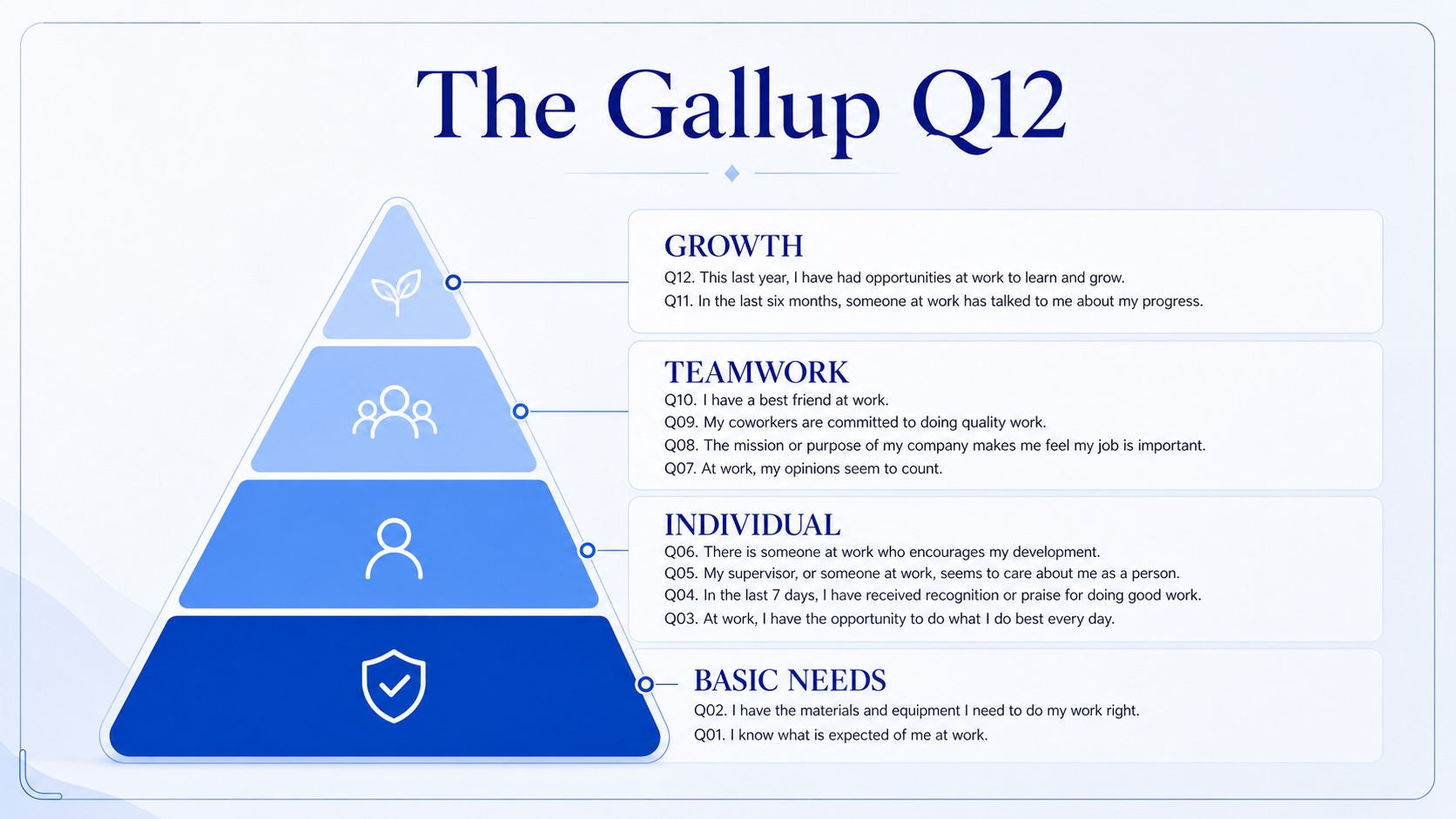
The survey asks twelve straightforward questions. Each one sounds deceptively simple. Together, they map a hierarchy of workplace needs, from the most basic to the most aspirational.
Gallup groups the questions into four levels: basic needs, individual contribution, teamwork, and growth. The logic is that you cannot build engagement at the top of the hierarchy if the bottom is broken. Telling people the company mission matters when they do not even know what is expected of them is not inspiring. It is noise.
As Gallup describes it, the goal of the Q12 is not to improve satisfaction scores but to create a stronger workplace by identifying the conditions that link directly to profitability, lower turnover, and better customer outcomes.
The questions span four levels:
- Basic Needs (Level 1): I know what is expected of me at work. I have the materials and equipment I need to do my work right. In the last seven days, I have received recognition or praise for doing good work. My supervisor, or someone at work, seems to care about me as a person.
- Individual Contribution (Level 2): At work, my opinions seem to count. The mission or purpose of my company makes me feel my job is important. There is someone at work who encourages my development.
- Teamwork (Level 3): My associates or fellow employees are committed to doing quality work. I have a best friend at work. In the last six months, someone at work has talked to me about my progress.
- Growth (Level 4): This last year, I have had opportunities at work to learn and grow.
Also available on:


Your Friday Briefing on the
Future of Work
Future Work delivers research-backed insights, expert takes, and practical prompts—helping you and your team capture what matters, build critical skills, and grow into a future-ready force.
Get all-in-one coverage of AI, leadership, middle management, upskilling, DEI, geopolitics, and more.
Unsubscribe anytime. No spam guaranteed.

Stay Ahead in the Future of Work
Get AI-powered tips and tools in your inbox to work smarter, not harder.
Get the insider scoop to increase productivity, streamline workflows, and stay ahead of trends shaping the future of work.
Unsubscribe anytime. No spam guaranteed.

Stay Ahead in the Future of Work
Leading in the future of work is a breeze with FlexOS. Subscribe to our newsletters and stay ahead on AI, Remote Work, and Modern Management.
We curate the most current research, news, trends, and tools to let you work smarter, not harder.
Why Leaders Keep Misreading These Results
Most organizations use the Q12, or something like it, and then struggle to act on the data effectively.
One common pattern is treating low scores as a communication problem: we need to better articulate our purpose. The Q12, though, does not primarily measure whether people have heard the right messages. It measures whether they feel seen, supported, and useful in their day-to-day work.
Question four, recognition in the last seven days, is one of the most powerful predictors in the entire survey. Not annual bonuses. Not company-wide celebrations. Recognition, specifically, in the past week. From their manager, or someone close to the work.
The same applies to question five: does someone at work care about me as a person? Gallup's own research frames this as a management question. It falls almost entirely on the direct manager, which is why leadership is the real lever in building work worth doing.
As Gallup notes in its FAQ on the Q12: the best organizations understand that employee engagement is not an isolated initiative but the way they do business. That gap between knowing and doing is where most organizations lose ground.
The Manager Problem Inside the Data
This is where the Q12 data becomes genuinely difficult to ignore.
As Jim Harter, Gallup's Chief Scientist for Workplace, shared with us in an interview: "Our research shows that managers account for at least 70% of variance in employee engagement scores."
That figure comes from Gallup's State of the American Manager report, drawing on data across millions of employees. And what it means in practice is that two people with identical roles, identical pay, and identical company culture can have completely different employee happiness experiences, depending entirely on who they report to.
Gallup CEO Jon Clifton has framed the urgency of this clearly:
"The emotional economy at work is now in a recession. If the very human spirit at work is in decline, so will be productivity."
The Q12 score is, in many ways, a mirror held up to the management layer.
How to Use the Q12 to Actually Change Things
Running the survey is the easy part.
Gallup's own guidance on how to act on the results points to several consistent principles:
Start with the bottom of the hierarchy. Gallup's four-level framework is clear that basic needs, clarity of expectations, having the right tools, and basic recognition, must be functioning before higher-level conditions like purpose and growth can take hold.
Treat low scores as diagnostic, not judgmental. A low score on question one (clarity of expectations) is not a verdict on your team. It is a signal that something in how work is communicated and structured needs attention. Gallup recommends that managers share results with their teams directly and open a conversation about what is driving them.
Give managers their team's data. Gallup recommends that all managers with a sufficient number of respondents receive their own team's results, not only company-level aggregates. Aggregate-only reporting removes accountability from where engagement is actually created or destroyed: the team level.
Close the loop visibly. Nothing undermines survey trust faster than silence after results come in. Even a brief acknowledgement of what was heard, and what will change, signals that the exercise was real. Gallup consistently finds that employees who feel their feedback is acted on are more likely to stay engaged in subsequent cycles.
Make it a conversation, not a compliance exercise. Gallup's guidance is explicit: the manager's role is to facilitate open discussion among team members about the engagement results and the team's plan for improvement. The Q12 is most useful as a starting point for dialogue, not as a number to report upward.
The Deeper Connection to Happiness at Work
The Q12 is a useful diagnostic tool. But it is worth stepping back and asking what it is really measuring.
Every question on that list is, at its core, about whether a person feels they matter at work. Whether their effort is noticed. Whether their growth is someone's concern. Whether the work connects to something worth doing. These are the conditions that underpin not just engagement, but genuine happiness at work in the fullest sense.
The fact that most organizations are still failing them, after decades of research and billions spent on engagement programs, suggests the problem is not a lack of data. It is a lack of priority.
Your Friday Briefing on the
Future of Work
Future Work delivers research-backed insights, expert takes, and practical prompts—helping you and your team capture what matters, build critical skills, and grow into a future-ready force.
Get all-in-one coverage of AI, leadership, middle management, upskilling, DEI, geopolitics, and more.
Unsubscribe anytime. No spam guaranteed.
Stay Ahead in the Future of Work
Get AI-powered tips and tools in your inbox to work smarter, not harder.
Get the insider scoop to increase productivity, streamline workflows, and stay ahead of trends shaping the future of work.
Unsubscribe anytime. No spam guaranteed.
Stay Ahead in the Future of Work
Leading in the future of work is a breeze with FlexOS. Subscribe to our newsletters and stay ahead on AI, Remote Work, and Modern Management.
We curate the most current research, news, trends, and tools to let you work smarter, not harder.
FAQ: The Gallup Q12
What is the Gallup Q12?
The Gallup Q12 is a 12-item survey that measures employee engagement. Developed by Gallup through decades of workplace research, it identifies the conditions that drive productivity, retention, and business outcomes.
How reliable is the Gallup Q12?
Gallup's Q12 meta-analysis covers hundreds of thousands of business units across millions of employees. It is one of the most extensively validated engagement instruments in existence, with consistent links to business performance metrics including profitability, customer satisfaction, and turnover.
How often should you run the Gallup Q12?
Annually is common, but Gallup recommends more frequent pulse checks on the highest-impact questions, particularly those relating to recognition and expectations, since these can shift quickly based on manager behavior.
Who should see the Q12 results?
Gallup recommends that individual managers receive their own team's data, not only company-level aggregates. Aggregate-only reporting removes accountability from where engagement is actually created or destroyed: the team level.
What is a good Gallup Q12 score?
Gallup classifies employees as engaged, not engaged, or actively disengaged. Globally, only 23% fall into the engaged category. High-performing organizations typically have engagement rates significantly above this baseline, which illustrates how much headroom most teams still have.


.webp)

![[Research Report] Rethinking the Workweek: The Push for Fewer Work Hours, More Life](https://cdn.prod.website-files.com/6442419dcf656a81da76b503/67f62ad0c3f263946ab76bf6_67eb9ea7f1a4e15aa02357f9_67dbcc5cd852e0468b7c1ab5_67d9294873eb0f3d06db0522_67d3e3773b52fb1458bbeca9_67cfeef562a442c6b5cac417_67ce9d783f83a316431e99fb_67c805f1e959c187503b6f9a_67c6b466f85f6718abc84402_67c562f18bb2e90006fefb91_67c01ccf46d56e67e92b4a6c_67becb6ce25a88249e237189_67b590c86adb9081bf7caffb_67a31bbd70980f65543d6140_6790a675ad20d4456fda7112_678f83dd8d45ccd6bdcc0504_Rethinking-the-workweek.avif)


![[Report] The Top 100 AI for Work – March 2024](https://cdn.prod.website-files.com/6442419dcf656a81da76b503/670defe3518d73b50509fa03_6708cccc5300ba0a7c209e41_news-top-100-ai-for-work-march-2024.avif)