


Gallup just released their State of the Global Workplace: 2026 Report, and the findings cut right to the heart of what we care about at FlexOS: global employee engagement fell to 20% in 2025, the lowest since the pandemic and the second consecutive year of decline.

That means four out of every five workers are not engaged at work: not thriving, not doing their best and feeling excited about it, just being there.
Employee engagement is not an abstract metric: it's a proxy for whether work is actually good for the people doing it, and right now, for most people, it isn't.
The People Hurting Most Are the Ones Carrying Everyone Else
The headline number is bad, but it's the breakdown that I keep coming back to.
While engagement among individual contributors has stayed roughly flat, the decline is almost entirely driven by managers, who have seen their engagement drop nine percentage points since 2022.
Think about who managers are: they're coaching their teams, absorbing pressure from above, dealing with restructuring and uncertainty, and now being asked to lead their people through an AI transition nobody fully understands yet, all largely without support.
And they're crucial for AI adoption: within U.S. organizations implementing AI, employees who strongly agree their manager actively supports their team's use of AI are 8.7 times more likely to say AI has transformed how work gets done, and 7.4 times more likely to say AI gives them more opportunities to do what they do best.
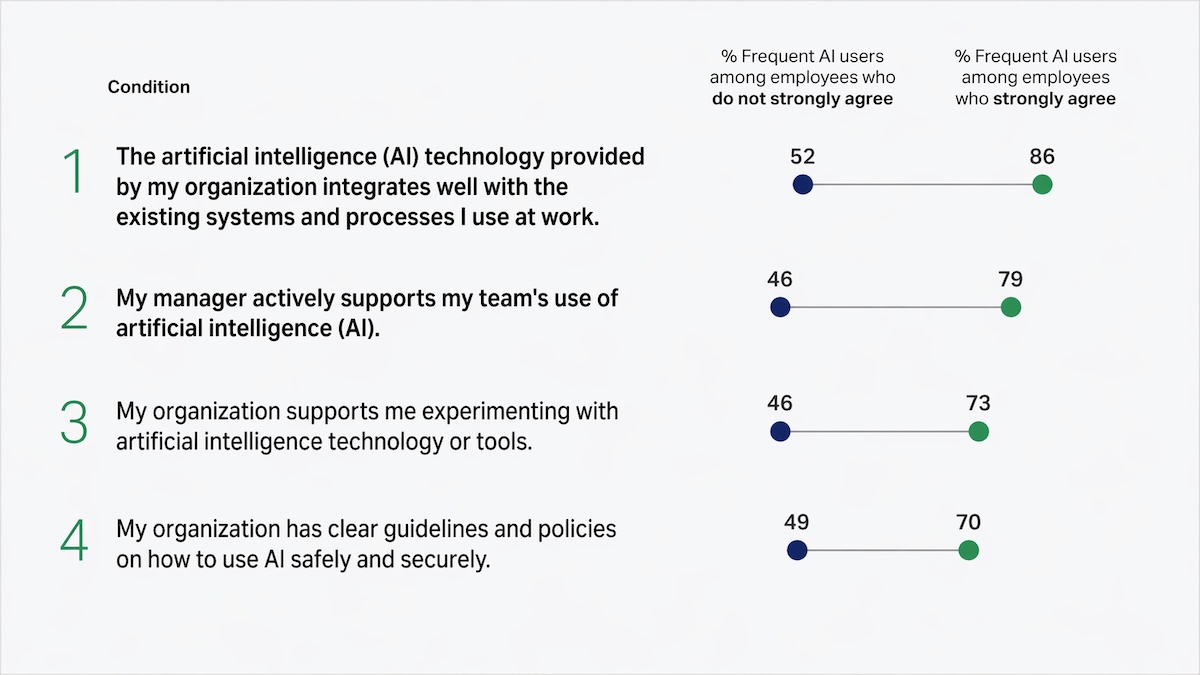
Yet fewer than one in three U.S. employees in AI-implementing organizations strongly agree their manager actively supports their team's use of the technology. In Germany it's 21%.
The demographic specifics are hard to look at.
Female managers saw a seven-point drop in engagement, and managers under 35 saw five points. These are not people who have given up on work. These are people who worked hard to get into leadership and are finding it increasingly difficult to stay motivated.
Leaders report higher engagement and wellbeing than other employees — but compared to individual contributors, they are substantially more likely to experience stress (+7 points), anger (+12 points), sadness (+11 points), and loneliness (+10 points) on any given day.
They are also less likely than individual contributors to say they smiled or laughed a lot the previous day. The report notes directly:
"Leadership can also mean greater social distance and the responsibility for making painful choices that affect many people's lives."
When leaders are engaged, all those numbers flip: they report negative emotions at lower rates than individual contributors and are 14 points more likely to be thriving.
We're Optimizing for the Wrong Things
This connects to something I've written about before on the topic of happiness at work: we are genuinely bad at knowing what makes people thrive at work.
Organizations keep reaching for the obvious levers: promotions, pay, and perks.
These things feel meaningful, and they do produce a burst of happiness, but research on the hedonic treadmill is clear that the effect doesn't last. A month after the raise, it feels normal, and we start looking for the next thing.
What actually sustains people is harder to manufacture.
When I interviewed Tracy Brower for the FlexOS podcast, she described four real components of happiness at work:
- Dedication: feeling genuinely committed to your work and what it stands for
- Immersion: losing track of time because you're absorbed in something meaningful
- Energy: feeling fueled rather than drained by the work you do
- Mattering: believing that what you do has purpose beyond the paycheck
None of these come from a new software platform.
They come from good work, with good people, with someone in your corner.
And BCG research I've covered here before makes the business case clearly: employees who enjoy their work are 49% less likely to consider leaving than those who don't, and companies with happy employees outperform their stock market peers by 12%. Joy is not soft, and ignoring it is expensive.
Even the Leaders Are Struggling
In the U.S. and Canada, which still lead the world in engagement at 31%, only 51% of workers describe themselves as "thriving," a new low for a region that used to be a benchmark.
Gallup also found something counterintuitive: higher-level leaders report higher engagement than other employees, but they are also more likely to experience stress, anger, sadness, and loneliness. The people at the top are not exempt from this.
The average person spends 90,000 hours at work over a lifetime, and if most of those hours are draining rather than energizing, that is a significant portion of a human life. That's what I care about, and that's why this report matters.
What Organizations Can Actually Do
There's a genuinely hopeful finding in all of this.
Within best-practice organizations, 79% of managers are engaged, nearly four times the global average, and these organizations exist in every industry and every region. The gap between them and everyone else is not luck or culture type; it comes down to deliberate choices.
When managers receive role-specific training and ongoing support, their wellbeing jumps from 28% to 50%, a remarkable return from a single targeted intervention.
And Gallup estimates that if every organization reached these best-practice engagement levels, the global economy would add $9.6 trillion in value, not from a new technology but from taking the human experience of work seriously.
The practical question for leaders is not whether to invest in AI: of course you should. Used well, AI can absorb the administrative GED-RT work that drains people: the repetitive tasks, the low-value processing, the stuff that eats hours and gives nothing back.
But as BCG's Debbie Lovich argues, and I think she's right, the critical question is what the AI is being pointed at. If it takes over the collaborative and human parts of the job — the work people actually find most meaningful — you haven't improved the employee experience, you've hollowed it out.
BCG's research shows that employee-centric organizations are seven times more likely to succeed with AI, which means the human investment and the AI investment are not in competition; one enables the other.
That's the version of the AI era I want to see, and I think it's still possible to get there.
Also available on:


Your Friday Briefing on the
Future of Work
Future Work delivers research-backed insights, expert takes, and practical prompts—helping you and your team capture what matters, build critical skills, and grow into a future-ready force.
Get all-in-one coverage of AI, leadership, middle management, upskilling, DEI, geopolitics, and more.
Unsubscribe anytime. No spam guaranteed.

Stay Ahead in the Future of Work
Get AI-powered tips and tools in your inbox to work smarter, not harder.
Get the insider scoop to increase productivity, streamline workflows, and stay ahead of trends shaping the future of work.
Unsubscribe anytime. No spam guaranteed.

Stay Ahead in the Future of Work
Leading in the future of work is a breeze with FlexOS. Subscribe to our newsletters and stay ahead on AI, Remote Work, and Modern Management.
We curate the most current research, news, trends, and tools to let you work smarter, not harder.
Your Friday Briefing on the
Future of Work
Future Work delivers research-backed insights, expert takes, and practical prompts—helping you and your team capture what matters, build critical skills, and grow into a future-ready force.
Get all-in-one coverage of AI, leadership, middle management, upskilling, DEI, geopolitics, and more.
Unsubscribe anytime. No spam guaranteed.
Stay Ahead in the Future of Work
Get AI-powered tips and tools in your inbox to work smarter, not harder.
Get the insider scoop to increase productivity, streamline workflows, and stay ahead of trends shaping the future of work.
Unsubscribe anytime. No spam guaranteed.
Stay Ahead in the Future of Work
Leading in the future of work is a breeze with FlexOS. Subscribe to our newsletters and stay ahead on AI, Remote Work, and Modern Management.
We curate the most current research, news, trends, and tools to let you work smarter, not harder.


.webp)

![[Research Report] Rethinking the Workweek: The Push for Fewer Work Hours, More Life](https://cdn.prod.website-files.com/6442419dcf656a81da76b503/67f62ad0c3f263946ab76bf6_67eb9ea7f1a4e15aa02357f9_67dbcc5cd852e0468b7c1ab5_67d9294873eb0f3d06db0522_67d3e3773b52fb1458bbeca9_67cfeef562a442c6b5cac417_67ce9d783f83a316431e99fb_67c805f1e959c187503b6f9a_67c6b466f85f6718abc84402_67c562f18bb2e90006fefb91_67c01ccf46d56e67e92b4a6c_67becb6ce25a88249e237189_67b590c86adb9081bf7caffb_67a31bbd70980f65543d6140_6790a675ad20d4456fda7112_678f83dd8d45ccd6bdcc0504_Rethinking-the-workweek.avif)


![[Report] The Top 100 AI for Work – March 2024](https://cdn.prod.website-files.com/6442419dcf656a81da76b503/670defe3518d73b50509fa03_6708cccc5300ba0a7c209e41_news-top-100-ai-for-work-march-2024.avif)