

Gallup's State of the Global Workplace: 2026 Report found that managers have seen their engagement drop nine percentage points since 2022, the steepest decline of any group in the workforce. Not frontline workers. Not junior employees. The leaders.
If you're a senior leader reading this, that number probably doesn't surprise you. You might even recognize it.
A lot of leaders I talk to describe themselves as fine. Functioning. Productive, even. But not quite alive in their work the way they used to be, or the way they thought they would be by now.
And when I ask what they're optimizing for, the honest answer is usually: getting through it. Performing well. Keeping people happy. Including themselves.
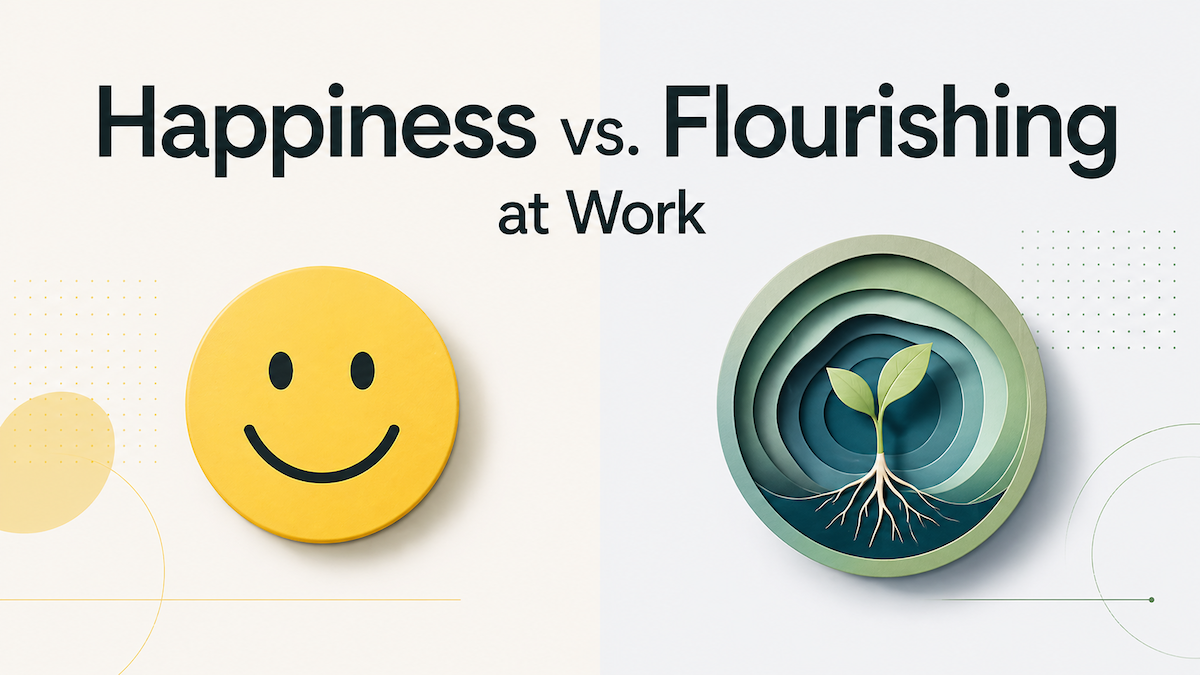
That's the trap. Because happiness and flourishing are not the same thing. And if you're chasing one when you need the other, no amount of optimization will get you where you actually want to go.
What Happiness Actually Is
Happiness refers to subjective wellbeing: how good you feel right now. Positive emotions, satisfaction, the absence of distress. It's real, it matters, and it's worth having.
Happiness at work, for most, is therefore "experience of joy, contentment, or positive well-being."
But it's a snapshot. And it's reactive. It responds to conditions: a good meeting, a win, a moment of recognition. It also disappears just as fast. A difficult conversation, a strategic setback, a week of relentless pressure, and it's gone.
The deeper problem is that happiness is easy to manufacture, for yourself and for others.
A promotion produces a burst of it. So does a long weekend, a compliment from someone you respect, a quarter that went well. But as research on the hedonic treadmill shows, the effect fades quickly. You adapt, and then you're back where you started, looking for the next thing.
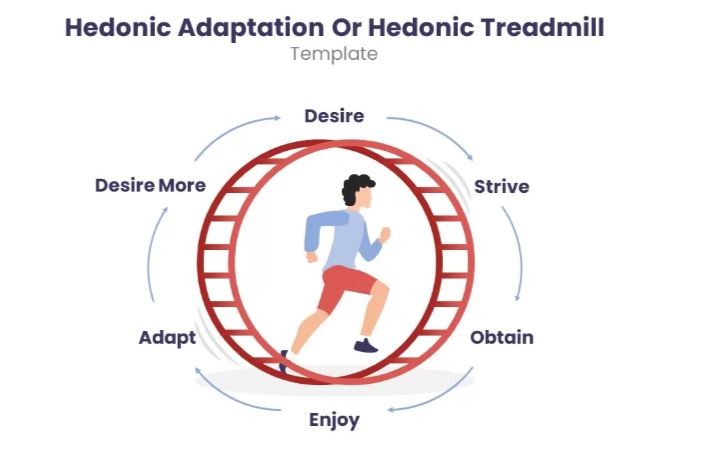
A lot of high-performing leaders live on this treadmill for years without naming it.
What Flourishing Actually Is
Flourishing comes from the Aristotelian concept of eudaimonia: not feeling good, but living in full expression of your capabilities. Being well. Becoming more fully yourself over time.
Martin Seligman, widely considered the father of positive psychology, spent years studying happiness before concluding it wasn't the right measure. His shift is captured in a quote from Flourish:
"I used to think that the topic of positive psychology was happiness, that the gold standard for measuring happiness was life satisfaction, and that the goal of positive psychology was to increase life satisfaction. I now think that the topic of positive psychology is well-being, that the gold standard for measuring well-being is flourishing, and that the goal of positive psychology is to increase flourishing."Martin Seligman, Flourish (2011)
His PERMA model captures flourishing across five dimensions: Positive emotion, Engagement, Relationships, Meaning, and Accomplishment. Only one of those is about feeling good in the moment. The other four are about how you're living, growing, and connecting.
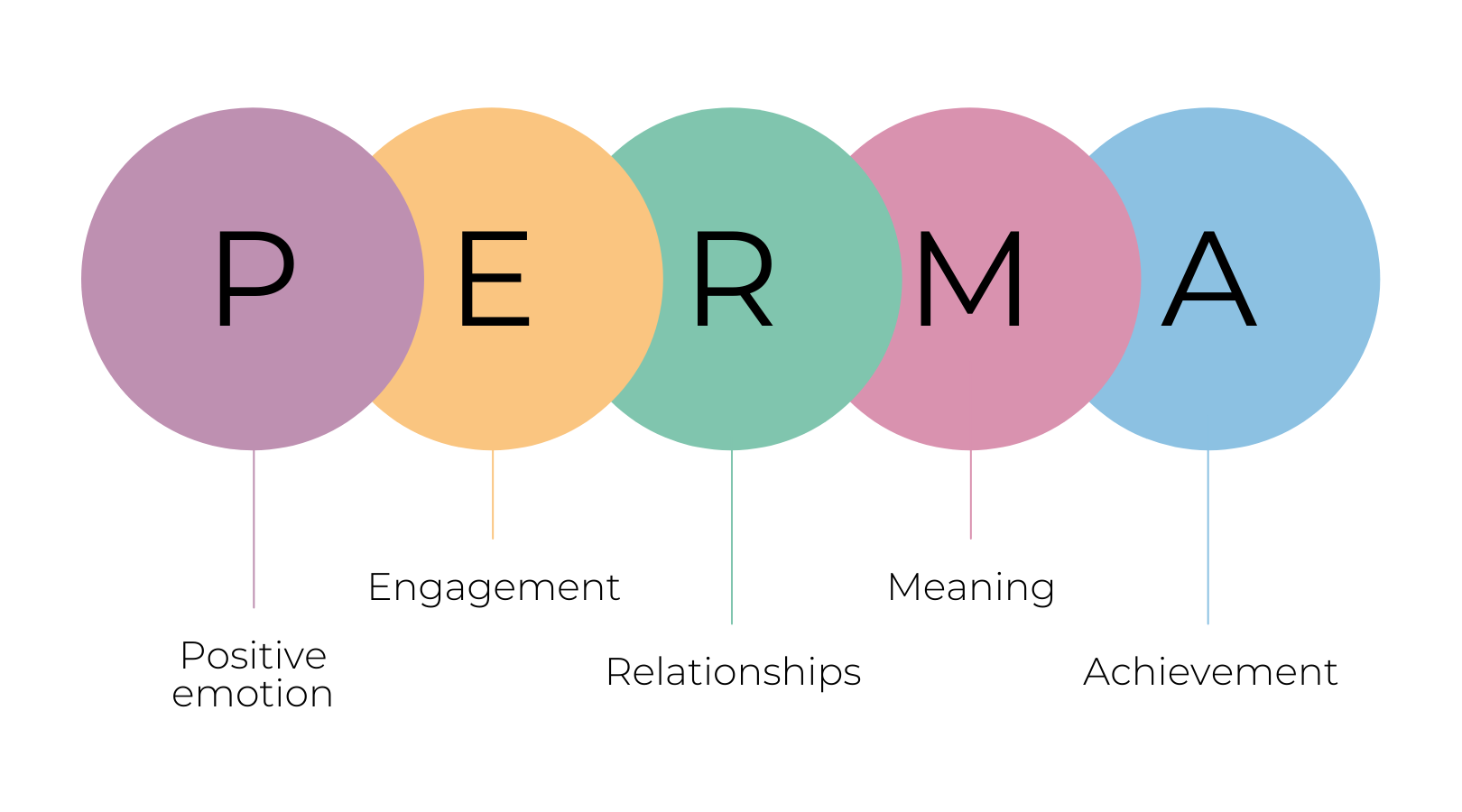
As Seligman puts it plainly:
"I'm trying to broaden the scope of positive psychology well beyond the smiley face. Happiness is just one-fifth of what human beings choose to do."
When I interviewed Tracy Brower for the FlexOS podcast, she described four real components of happiness at work that point in this same direction: dedication, immersion, energy, and mattering. What strikes me about that list is that none of it is circumstantial. You can't get there by changing your conditions. You get there by changing what you're doing and why.
Flourishing is also durable in a way happiness isn't. It persists through hard stretches, through ambiguity, through work that doesn't feel good while you're doing it but builds something real. Ask anyone who has led through a genuine crisis, or built something from nothing: it wasn't always pleasant. But it was full.
Why This Distinction Matters for You Specifically
Here's what the Gallup data shows about leaders that I find genuinely important: higher-level leaders report greater engagement overall, but are also substantially more likely to experience stress, anger, sadness, and loneliness on any given day compared to individual contributors.
In other words, you can be engaged and still be depleted. You can be performing well and still feel like something essential is missing.
This is exactly where the happiness/flourishing distinction becomes practical. If you're optimizing for happiness, reducing friction, smoothing out the hard parts, staying comfortable, you will keep feeling okay and keep feeling like something is missing. Because happiness doesn't require you to grow. Flourishing does.
The question worth sitting with isn't "how do I feel better?" It's:
- Am I becoming more fully myself in this work?
- Am I building something I actually care about?
- Is this the leader I want to be?
The AI Question Hiding Underneath All of This
AI is giving many leaders time back. Hours, in some cases. The assumption is that recovered time equals better work and better wellbeing.
I don't think that follows automatically. If you fill recovered time with more of the same work that wasn't feeding you before, you haven't improved your situation. You've just made the treadmill faster.
The more interesting question is what you do with the hours AI returns. Whether you use them to go deeper on the work that actually matters to you, to think more clearly, to lead more intentionally. Or whether you fill them with more output because that's what the system expects and you haven't yet asked what you actually want instead.
That's a flourishing question. And it requires having thought through the difference first.
Then It Becomes About Others
Here's what the same Gallup report shows: when leaders are genuinely engaged, not just functional but actually thriving, they report negative emotions at lower rates than individual contributors and are 14 points more likely to be thriving overall. The people around them follow.
In organizations where managers receive genuine support, manager wellbeing jumps from 28% to 50%. Employees whose managers actively support their use of AI are 8.7 times more likely to say it has transformed how work gets done.
The throughline is the same: nothing works unless the leader is okay first. Not performing okay. Actually okay.
You cannot help your team flourish from a place of quiet depletion. You can manage them, direct them, and keep the metrics looking reasonable. But the kind of leadership that makes people feel like their work matters and their growth is real, that only comes from a leader who has done this work themselves.
The difference between happiness and flourishing at work isn't an abstract philosophical question. It's the question underneath every leadership challenge worth taking seriously.
Frequently Asked Questions
What is the difference between happiness and flourishing at work?Happiness refers to how good you feel in the moment: positive emotions, satisfaction, low stress. Flourishing is broader and more durable: it means living in full expression of your capabilities, doing meaningful work, growing, and building real relationships. You can be happy at work without flourishing, and you can flourish through genuinely hard periods that aren't happy at all.
Why is flourishing more important than happiness for leaders?Because happiness is reactive and temporary, while flourishing is something you build over time. Leaders who only optimize for feeling good tend to stay on the hedonic treadmill: chasing the next win, the next raise, the next milestone. Flourishing requires asking harder questions about what kind of work and leader you actually want to be.
What is Martin Seligman's PERMA model?PERMA is Seligman's framework for human flourishing, built on five elements: Positive emotion, Engagement, Relationships, Meaning, and Accomplishment. Only one of the five is about feeling good in the moment. The rest are about how deeply you're living and growing. Seligman developed it after concluding that happiness alone was too narrow a measure of a well-lived life.
Can you flourish at work even when you're not happy?Yes. Seligman is explicit on this point: you can have meaning, engagement, strong relationships, and accomplishment even during difficult periods. Flourishing makes room for hard work, ambiguity, and even suffering. It's not the absence of difficulty. It's the presence of depth.
How does AI affect flourishing at work?AI creates the opportunity to reclaim time from low-value, draining tasks. But that time only improves your working life if you redirect it toward work that actually feeds your flourishing: deeper thinking, more meaningful leadership, the work you've been putting off because the urgent kept crowding out the important. Used thoughtlessly, AI just makes the treadmill faster.
Also available on:


Your Friday Briefing on the
Future of Work
Future Work delivers research-backed insights, expert takes, and practical prompts—helping you and your team capture what matters, build critical skills, and grow into a future-ready force.
Get all-in-one coverage of AI, leadership, middle management, upskilling, DEI, geopolitics, and more.
Unsubscribe anytime. No spam guaranteed.

Stay Ahead in the Future of Work
Get AI-powered tips and tools in your inbox to work smarter, not harder.
Get the insider scoop to increase productivity, streamline workflows, and stay ahead of trends shaping the future of work.
Unsubscribe anytime. No spam guaranteed.

Stay Ahead in the Future of Work
Leading in the future of work is a breeze with FlexOS. Subscribe to our newsletters and stay ahead on AI, Remote Work, and Modern Management.
We curate the most current research, news, trends, and tools to let you work smarter, not harder.
Your Friday Briefing on the
Future of Work
Future Work delivers research-backed insights, expert takes, and practical prompts—helping you and your team capture what matters, build critical skills, and grow into a future-ready force.
Get all-in-one coverage of AI, leadership, middle management, upskilling, DEI, geopolitics, and more.
Unsubscribe anytime. No spam guaranteed.
Stay Ahead in the Future of Work
Get AI-powered tips and tools in your inbox to work smarter, not harder.
Get the insider scoop to increase productivity, streamline workflows, and stay ahead of trends shaping the future of work.
Unsubscribe anytime. No spam guaranteed.
Stay Ahead in the Future of Work
Leading in the future of work is a breeze with FlexOS. Subscribe to our newsletters and stay ahead on AI, Remote Work, and Modern Management.
We curate the most current research, news, trends, and tools to let you work smarter, not harder.


.webp)

![[Research Report] Rethinking the Workweek: The Push for Fewer Work Hours, More Life](https://cdn.prod.website-files.com/6442419dcf656a81da76b503/67f62ad0c3f263946ab76bf6_67eb9ea7f1a4e15aa02357f9_67dbcc5cd852e0468b7c1ab5_67d9294873eb0f3d06db0522_67d3e3773b52fb1458bbeca9_67cfeef562a442c6b5cac417_67ce9d783f83a316431e99fb_67c805f1e959c187503b6f9a_67c6b466f85f6718abc84402_67c562f18bb2e90006fefb91_67c01ccf46d56e67e92b4a6c_67becb6ce25a88249e237189_67b590c86adb9081bf7caffb_67a31bbd70980f65543d6140_6790a675ad20d4456fda7112_678f83dd8d45ccd6bdcc0504_Rethinking-the-workweek.avif)


![[Report] The Top 100 AI for Work – March 2024](https://cdn.prod.website-files.com/6442419dcf656a81da76b503/670defe3518d73b50509fa03_6708cccc5300ba0a7c209e41_news-top-100-ai-for-work-march-2024.avif)