

Human flourishing at work is not a wellness initiative. It is not an engagement score. It is the condition in which a person is doing work that genuinely fits who they are, growing through it, and contributing something that matters to them.
By almost every measure, we have built the most productive work culture in history. We have also built one of the least fulfilling.
Gallup's most recent global data puts employee engagement at roughly 20%. That means eight in ten workers are either going through the motions or actively miserable.
This is not a problem at the bottom of the org chart. It reaches into senior levels, where the isolation, performance pressure, and identity entanglement are often more acute, just better disguised.
This article defines what human flourishing at work actually means, why leaders need it more than anyone, and the four conditions research shows are required to achieve it.
What Human Flourishing at Work Actually Means
The word flourishing comes from Aristotle's concept of eudaimonia, usually translated as happiness, but better understood as living and functioning well in the fullest sense.
Harvard's Human Flourishing Program defines it as a state in which all aspects of a person's life are good, including the environments in which they live.
That is a significantly higher bar than happiness. Happiness is a feeling, a state that comes and goes depending on circumstances. Flourishing is a condition, something that holds even when the day is hard, the project is failing, or the role is changing. You can be happy at work without growing. You can be unhappy and still be flourishing, because you are doing something that genuinely matters to you and building toward something real.
Understanding the difference between happiness and flourishing matters because most organizations optimize for the wrong thing. Ping pong tables and free lunches can lift happiness scores. They do very little for flourishing.
You can hit every target, maintain appearances, and generate excellent outputs while something essential in you quietly goes dark.
Flourishing at work is not merely the absence of strain. It is the presence of growth-oriented energy that enables people to adapt, innovate, and perform sustainably.
Viktor Frankl, psychiatrist, Holocaust survivor, and author of Man's Search for Meaning, put it plainly: what a person actually needs is not a tensionless state, but the striving and struggling for a worthwhile goal, a freely chosen task.
He wrote this after surviving four Nazi concentration camps. It is not an abstraction. It is a report from the extreme end of human experience about what keeps people alive and functioning when everything else has been stripped away.
The implication for work is direct: in the absence of meaning, even comfortable conditions become unbearable over time. And a lot of people are sitting in comfortable conditions, going quietly numb.
Why Leaders Need This More Than Anyone
The conversation about flourishing usually happens one level too low.
Organizations design wellbeing programs for the workforce. Meanwhile, the leader is expected to be the generator of all this: the source of purpose, the model of engagement, the keeper of culture.
And nobody asks how they're doing.
Executives often become so entangled with the enormity of their positions that they lose sight of their own need to stay connected to what is meaningful. Even in organizations with a genuinely important mission, leaders need to continually reconnect themselves before they can reconnect anyone else.
This is the core insight that reorganizes everything else.
Culture is not a program you design and install. It is a climate that flows almost entirely from the quality of the leader's own inner life.
- A leader who has never examined what makes their work meaningful will struggle to help others find meaning.
- A leader who has outsourced authorship of their own working life to their calendar cannot credibly model agency.
- A leader who needs the title to know who they are will, under pressure, protect the title at the expense of nearly everything else.
The journey inward is not self-indulgent. It is the prerequisite.
You cannot pay forward what you haven't yet inhabited.
The Four Conditions for Human Flourishing at Work
Decades of research in motivation psychology, positive organizational behavior, and the emerging science of workplace wellbeing converge on a consistent answer.
Flourishing requires four conditions. They build on each other in sequence. Each one stabilizes the next.
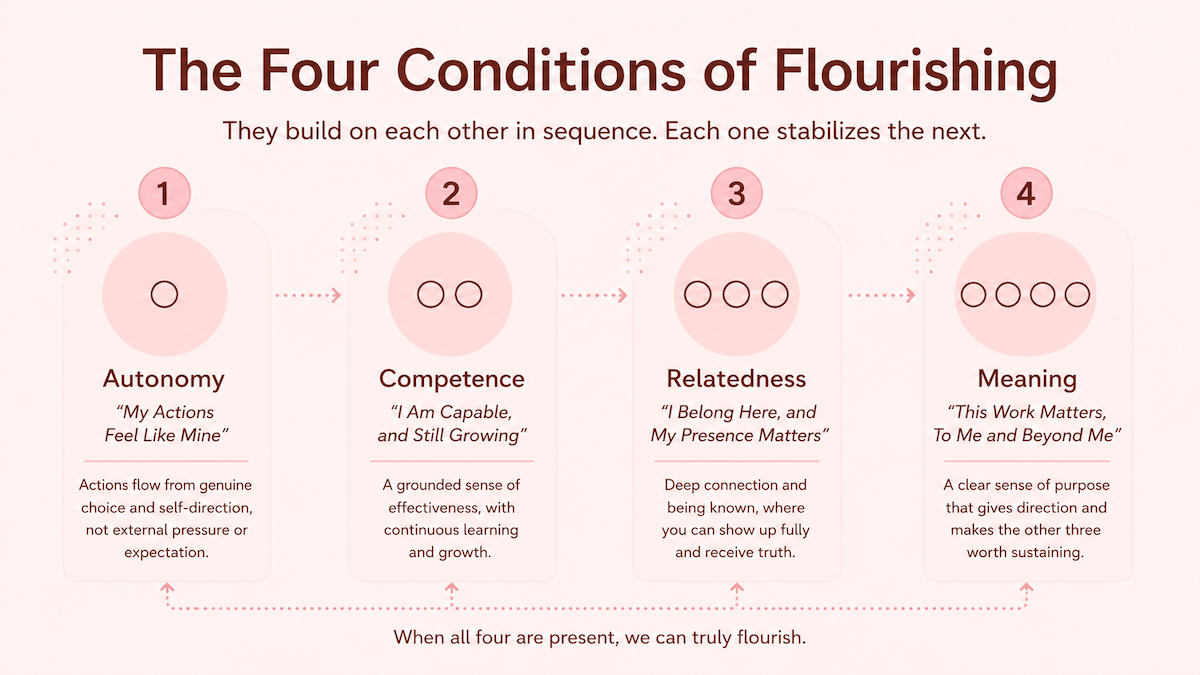
1. Autonomy: "My Actions Feel Like Mine"
Self-Determination Theory, developed by Deci and Ryan over four decades of research, identifies autonomy as the foundational psychological need at work. The primary focus is on people's need to be volitional and self-initiate their own actions, rather than be controlled and directed by others.
Most people reduce autonomy to a scheduling question: do I have flexibility? Can I work from home?
These things matter. But they are the surface version of a deeper inquiry.
The real autonomy question is whether your actions feel like yours.
Not whether you are free from constraints. Whether you are acting from genuine volition, or from a tangled web of external pressure, status anxiety, and inherited expectations you never consciously chose.
Many leaders have significant formal authority and almost no actual autonomy in this sense. They are managing the perception of being in control while being driven by forces they have never examined.
Research consistently shows that when leaders experience support for autonomy, they also tend to feel more connected and more effective. The autonomy orientation appears to unlock the other needs.
This is why it comes first. A leader who hasn't genuinely claimed their own agency will, often unconsciously, eliminate agency in others. Control begets control.
The diagnostic question: not "do I have authority?" but "when I make decisions, am I acting from what I actually believe, or from what I think is expected of me?"
2. Competence: "I Am Capable, and Still Growing"
Ryan and Deci identify the need for competence as essential for optimal functioning. People need to feel effective in their interactions with the environment, to experience mastery, and to have genuine opportunities for growth.
This is not confidence. Confidence is often a performance, a way of managing other people's perceptions of you.
Grounded competence is quieter and more honest: a genuine belief in your capacity to meet what the work demands, combined with active movement toward what you cannot yet do.
For senior leaders, this pillar has a specific trap.
Expertise accumulated early in a career can calcify into identity. When that happens, growth starts to feel threatening rather than generative, because being a beginner at something new creates momentary incompetence, and incompetence has become confused with unworthiness.
The leader who can no longer be taught, who finishes everyone's sentences, who steers every conversation back to what they already know: this is not a confident person. It is a person who has allowed their competence to become a defensive structure.
Research shows that SDT-aligned practices produce higher engagement, greater creativity, lower burnout, and reduced turnover. The key insight: most management focuses on external motivation while neglecting the conditions that produce genuine autonomous motivation, of which real competence development is central.
The diagnostic question: are you still genuinely in motion, or managing the perception of it?
3. Relatedness: "I Belong Here, and My Presence Matters"
This is the hardest condition for senior leaders to admit needing.
The mythology of leadership prizes self-sufficiency. You arrived at the top by being capable, by solving problems, by not requiring much.
Needing people can feel like regression.
But research consistently shows that intrinsic motivation flourishes when linked with a sense of security and relatedness. When people believe those around them are uncaring or cold, motivation diminishes. Relatedness is not a nice-to-have. It is a nutrient.
The leader's version of this need is worth naming precisely.
It is not about having a large network.
It is not about being respected, which is abundant at senior levels and often profoundly isolating.
It is about having people at work, even one or two, with whom you are actually known rather than merely admired. People who will tell you something true. People in whose company you can think out loud, be uncertain, make mistakes, and not immediately manage the optics.
Google's Project Aristotle found that psychological safety was the single strongest predictor of team effectiveness, aligning directly with the need for relatedness. Managers who want genuinely motivated teams should focus less on incentive structures and more on creating environments where people feel truly connected.
Disconnection at the top is one of the most reliable predictors of poor judgment, poor culture, and burnout. Not because loneliness is uncomfortable, but because without relational grounding, a leader loses access to reality. Feedback loops close. Sycophancy intensifies. The gap between what they believe about themselves and what is actually happening widens.
The diagnostic question: is there anyone here who knows me well enough to tell me something I don't want to hear, and will I let them?
4. Meaning: "This Work Matters, To Me and Beyond Me"
Meaning is the capstone.
Autonomy without meaning is drift.
Competence without meaning is performance.
Relatedness without meaning is belonging to something hollow.
Meaning is what makes the other three cohere into something worth sustaining.
Research shows that when people feel they are pursuing work that is personally important, the effects are significant: reductions in stress, turnover, and cynicism, alongside increases in commitment, satisfaction, engagement, and a genuine sense of fulfillment. What matters is not the nature of the work itself, but the relationship between the individual and their work.
Meaning is not the exclusive property of obviously noble professions. It is not something an organization provides through a mission statement.
It is built, usually quietly and privately, through the specific ways a person understands why what they do matters and to whom.
Research by the Roffey Park Institute found that almost three quarters of leaders and managers are actively searching for a greater sense of meaning in their working lives.
Most are looking in the wrong direction, waiting for the organization to provide it, or believing that success at the next level will finally deliver it.
Meaning is not a reward for achievement. It is a prerequisite for the kind of achievement worth having.
For leaders, the honest inquiry is: can you articulate, not for the town hall but privately, why this work matters to you personally? And is there a credible line of sight between your daily reality and that answer?
Why the Sequence Matters
These four conditions are not a checklist. They build in a specific order, and that order is not arbitrary.
A leader who hasn't claimed real autonomy will develop strategically rather than honestly, acquiring skills for optics rather than from genuine curiosity.
A leader who doesn't feel genuinely capable will struggle to connect authentically, because real connection requires showing up as you actually are, uncertainty and all.
A leader who doesn't feel they belong somewhere will find it hard to sustain meaning when conditions get hard, because meaning needs a relational anchor. When things are difficult and you are isolated, the "why" hollows out quickly.
A leader who reaches for meaning without the first three will find it fragile: dependent on external validation, easily disrupted by setbacks.
The path runs inward before it runs outward.
This is, in most ways, the opposite of how leadership development is structured, which focuses almost entirely on outward-facing skills.
But the research is consistent. And so is the lived experience of anyone who has watched a technically brilliant leader leave a trail of wreckage behind them because they never asked the harder internal questions.
Flourishing at Work and the AI Question
AI is making this conversation more urgent in a specific way.
As AI absorbs more task-level work, the busyness that used to mask the absence of meaning disappears.
People are left with recovered time and, often, no clear answer to what they actually want to do with it.
Researchers studying AI's impact on work argue that meaning in life is deeply tied to identity and long-term commitments. Work is not just something people do. It is something they become. When that is disrupted, the consequences extend far beyond income. It becomes an existential challenge.
The question "what do I do with the hours AI gives back?" is not a scheduling question.
It is a meaning question.
And it cannot be answered well by someone who hasn't done the prior work: who they are, what they're genuinely capable of, who they belong with, and what they are actually here to do.
Key Takeaways: Human Flourishing at Work
- Human flourishing at work is not the same as happiness or engagement. It is the condition in which you are doing work that fits who you are, growing through it, and contributing something that genuinely matters to you.
- The four conditions for flourishing are autonomy, competence, relatedness, and meaning. They build in sequence. Each one stabilizes the next. Skipping steps produces flourishing that is fragile or false.
- Leaders need this work more than anyone, and are least likely to be asked to do it. Culture flows from the leader's inner life. You cannot build work worth doing for others if you haven't done the honest inquiry yourself.
- Meaning is not provided by the organization. It is built privately, through the specific ways a person understands why their work matters and to whom. Waiting for a mission statement to deliver it is a reliable path to disappointment.
- AI makes this conversation urgent, not abstract. As AI removes task-level work, the busyness that masked the absence of meaning disappears. The question of what you actually want to do with your working life is no longer deferrable.
Frequently Asked Questions about Flourishing at Work
What is human flourishing at work?
Human flourishing at work is the condition in which a person is doing work that fits who they are, growing through the process, and contributing to something that matters to them. It goes beyond satisfaction or engagement. It is a state of functioning well in the fullest sense, drawing on psychological research from Aristotle's concept of eudaimonia through to Deci and Ryan's Self-Determination Theory and Seligman's PERMA model.
What are the four conditions required for human flourishing at work?
Research points to four interconnected conditions: autonomy (the sense that your actions genuinely feel like yours), competence (honest belief in your capacity combined with real growth), relatedness (being known and belonging, not just respected or networked), and meaning (a personal, credible connection to why the work matters). These build on each other in sequence, with each one stabilizing the next.
Why do leaders struggle with flourishing at work more than others?
Leaders often face a specific version of this challenge. The mythology of leadership prizes self-sufficiency, which makes it harder to admit needing meaning, connection, or genuine growth. Senior roles also bring identity entanglement, where the title and the person become difficult to separate, and isolation, where feedback loops close and honest relationships become rare. Flourishing at the top requires more deliberate internal work, not less.
What is the difference between employee engagement and human flourishing?
Employee engagement typically measures behavioral commitment to an organization: whether people are putting in effort, recommending the company, intending to stay. Human flourishing is broader and more personal. It includes whether the work fits the person's identity, whether they feel genuine agency, whether they experience real growth, and whether they can articulate honestly why the work matters to them. A person can be engaged by organizational standards and still not be flourishing.
How does AI affect human flourishing at work?
AI accelerates the urgency of the flourishing question by removing the busyness that many people used, consciously or not, as a substitute for meaning. As AI handles more task-level work, people are left with recovered time and a clearer view of whether the work itself was actually fulfilling. Leaders who have already done the internal work on autonomy, competence, relatedness, and meaning will use that time well. Those who haven't will tend to fill it with more of the same, slightly faster.
Can human flourishing at work be measured?
Yes, though imperfectly. Validated tools include the PERMA-Profiler, adapted for workplace contexts, which measures positive emotions, engagement, relationships, meaning, and accomplishment. Self-Determination Theory researchers have developed scales measuring the satisfaction of autonomy, competence, and relatedness needs at work. Gallup's engagement index is a partial proxy. No single measure captures the full picture, which is part of why the conversation needs to move beyond engagement scores.
Also available on:


Your Friday Briefing on the
Future of Work
Future Work delivers research-backed insights, expert takes, and practical prompts—helping you and your team capture what matters, build critical skills, and grow into a future-ready force.
Get all-in-one coverage of AI, leadership, middle management, upskilling, DEI, geopolitics, and more.
Unsubscribe anytime. No spam guaranteed.

Stay Ahead in the Future of Work
Get AI-powered tips and tools in your inbox to work smarter, not harder.
Get the insider scoop to increase productivity, streamline workflows, and stay ahead of trends shaping the future of work.
Unsubscribe anytime. No spam guaranteed.

Stay Ahead in the Future of Work
Leading in the future of work is a breeze with FlexOS. Subscribe to our newsletters and stay ahead on AI, Remote Work, and Modern Management.
We curate the most current research, news, trends, and tools to let you work smarter, not harder.
Your Friday Briefing on the
Future of Work
Future Work delivers research-backed insights, expert takes, and practical prompts—helping you and your team capture what matters, build critical skills, and grow into a future-ready force.
Get all-in-one coverage of AI, leadership, middle management, upskilling, DEI, geopolitics, and more.
Unsubscribe anytime. No spam guaranteed.
Stay Ahead in the Future of Work
Get AI-powered tips and tools in your inbox to work smarter, not harder.
Get the insider scoop to increase productivity, streamline workflows, and stay ahead of trends shaping the future of work.
Unsubscribe anytime. No spam guaranteed.
Stay Ahead in the Future of Work
Leading in the future of work is a breeze with FlexOS. Subscribe to our newsletters and stay ahead on AI, Remote Work, and Modern Management.
We curate the most current research, news, trends, and tools to let you work smarter, not harder.


.webp)

![[Research Report] Rethinking the Workweek: The Push for Fewer Work Hours, More Life](https://cdn.prod.website-files.com/6442419dcf656a81da76b503/67f62ad0c3f263946ab76bf6_67eb9ea7f1a4e15aa02357f9_67dbcc5cd852e0468b7c1ab5_67d9294873eb0f3d06db0522_67d3e3773b52fb1458bbeca9_67cfeef562a442c6b5cac417_67ce9d783f83a316431e99fb_67c805f1e959c187503b6f9a_67c6b466f85f6718abc84402_67c562f18bb2e90006fefb91_67c01ccf46d56e67e92b4a6c_67becb6ce25a88249e237189_67b590c86adb9081bf7caffb_67a31bbd70980f65543d6140_6790a675ad20d4456fda7112_678f83dd8d45ccd6bdcc0504_Rethinking-the-workweek.avif)


![[Report] The Top 100 AI for Work – March 2024](https://cdn.prod.website-files.com/6442419dcf656a81da76b503/670defe3518d73b50509fa03_6708cccc5300ba0a7c209e41_news-top-100-ai-for-work-march-2024.avif)