

Work is not working, and the numbers just got worse
Gallup's State of the Global Workplace: 2026 Report landed with a thud. Global employee engagement fell to 20% in 2025, the lowest since the pandemic and the second consecutive year of decline.
Four out of every five workers are not engaged at work. Not thriving. Not doing their best and feeling good about it. Just being there.
And the decline is almost entirely driven by the people most responsible for engaging everyone else: managers. Manager engagement has dropped 9 percentage points since 2022. Female managers are down 7 points. Managers under 35 are down 5. They are not lazy, checked out, or quiet-quitting. They are burning out under pressure from above, AI uncertainty below, and very little support from either side.
Even the top is struggling. In the U.S. and Canada, the world's highest-engagement region at 31%, only 51% of workers describe themselves as "thriving", a new low. Leaders report more stress, anger, sadness, and loneliness than the individual contributors they manage.
This is the backdrop for any serious conversation about employee happiness in 2026. Employee engagement is a symptom. Happiness is the upstream variable, and right now, for most people, it is broken.
The good news: we actually know what fixes it. The better news: the companies that have fixed it exist in every industry and every region, and the gap between them and everyone else is not luck. It is deliberate choices.
This article lays out what employee happiness actually is, the research on what drives it, why measuring it directly is a trap, and the eight things leaders can do starting this week to move the numbers.
What is employee happiness?
The happiness researcher Sonja Lyubomirsky defines happiness as "the experience of joy, contentment, or positive well-being, combined with a sense that one's life is good, meaningful, and worthwhile."
Apply that to work, and employee happiness becomes:
The experience of joy, contentment, or positive well-being, combined with a sense that one's work life is good, meaningful, and worthwhile.
That definition matters because it forces leaders off the easy framing of "happy = smiling in the office." Happiness at work is not a mood. It is an evaluation. People decide whether their work life is good, meaningful, and worthwhile based on concrete conditions you can influence.
Best-selling author Tracy Brower, VP at Steelcase and author of The Secrets to Happiness at Work, breaks employee happiness down into four components:
- Dedication: feeling committed to the outcome.
- Immersion: the kind of work where time flies.
- Energy: getting energized by the work and motivated to put energy into it.
- Mattering: the sense that the work you do has meaning.
Notice what is missing: salary, perks, Friday drinks, a kombucha tap. None of those are wrong. They are just not the thing.
The business case (with the numbers leaders need)
A quick roll-up of what the research says happens when employee happiness goes up:
OutcomeEffectProductivityHappy employees are 12% more productive (Warwick)Sales performanceHappy salespeople sell 37% moreStock performanceCompanies with happy employees outperform peers by 12%RetentionEmployees who enjoy their work are 49% less likely to consider quitting (BCG)TeamworkHappy team members are 58% more likely to help colleagues, and teamwork rises 23%Sick daysStress drives 75–90% of primary-care visits
BCG's Debbie Lovich pulled the retention number apart even further in our interview and found something sharper still: when she asked employees "are you looking for a new job?", the share saying "no, I'm not looking" jumps from the 30s among people who dislike their work to the 70s among those who enjoy it. Joy doesn't just reduce attrition risk. It roughly doubles retention.
BCG calls the gap between this evidence and what most companies actually do "a blind spot that could result in losing key talent." As CultureRX's David Scouler put it: the topic of joy should be on the agenda of every board meeting.
Gallup's 2026 analysis adds a macro number: if every organization reached the engagement levels of best-practice companies, the global economy would add $9.6 trillion in value. Not from a new technology. From taking the human experience of work seriously.
And here is the uncomfortable twist for most HR strategies. In the BCG study of over 11,000 workers, emotional drivers (feeling fairly treated, feeling respected, feeling supported, doing work you enjoy) dominated the list of what actually makes people stay. Pay dropped to number 15.
As Lovich framed it: pay gets people to apply and accept. Emotional factors are what get them to stay. If pay ranked 15th and you are still leading with pay, you have a strategy problem.
A separate analysis by Irrational Capital, co-founded by behavioral economist Dan Ariely, puts a sharper number on this. After studying 7,500 publicly listed companies across the S&P 500 and Russell 1000 using employee perception data, they found that companies in the top 20% for workplace well-being outperform the S&P 500 by an average of 520 basis points. No financial ratios, no earnings metrics — purely the human capital factor. That is not a rounding error. It is a structural advantage hiding in plain sight.
The science: what actually makes employees happy
The most useful single framework in the happiness literature is Martin Seligman's PERMA model, the foundational work of the University of Pennsylvania's Positive Psychology Center:
- Positive emotions
- Engagement (flow)
- Relationships
- Meaning
- Accomplishment
PERMA is a useful scaffold because each element is something a leader or an organization can design for. Positive emotions can be cultivated. Engagement (flow) can be protected with focus time. Relationships can be structured in. Meaning can be articulated. Accomplishment can be recognized.
The newer "PERMA+" adds four fundamentals that plug in underneath: optimism, nutrition, physical activity, and sleep. Leaders often underweight these. If your team is sleeping badly and never sees daylight, no amount of purpose posters will fix it.
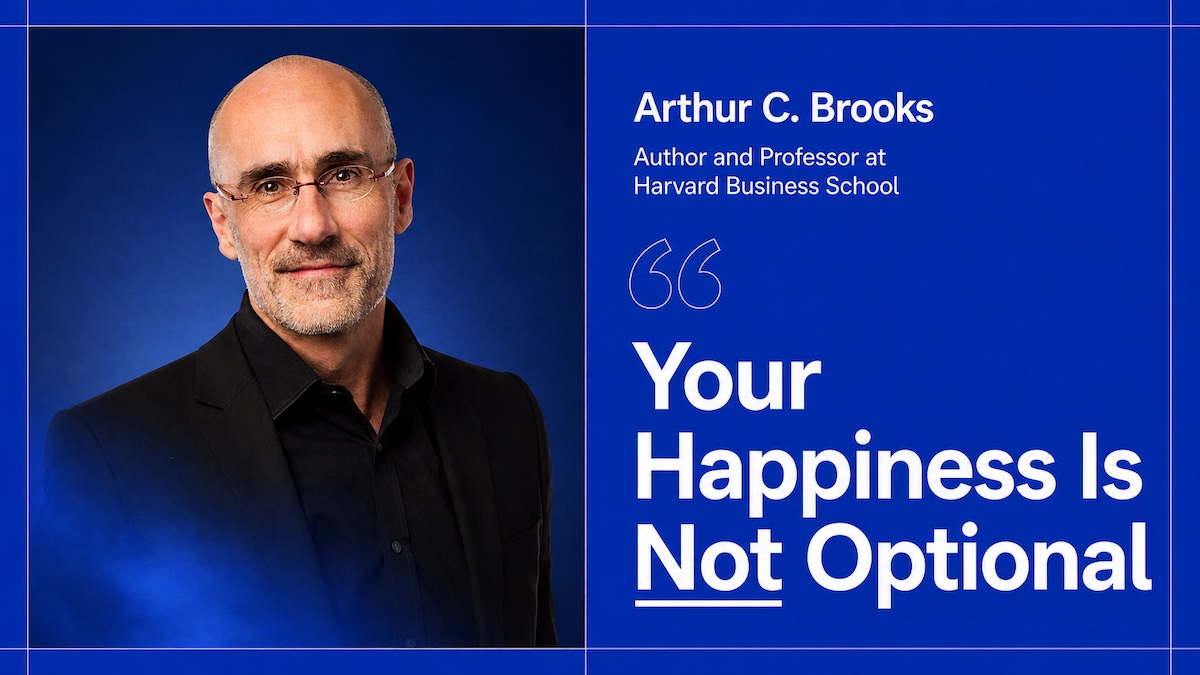
A complementary framework comes from Harvard professor Arthur C. Brooks, who identifies three macronutrients of happiness — enjoyment, satisfaction, and meaning — as the building blocks of a fulfilled work life. Where Seligman's PERMA maps the full architecture of flourishing, Brooks's macronutrients offer a practical diagnostic: if any one of the three is missing, the others cannot compensate. A team can find their work meaningful but joyless, or enjoyable but empty of satisfaction — and neither state sustains performance over time. Read more in our piece on how leaders can be happier at work.
A parallel piece of evidence is the World Happiness Report, produced every year by Gallup and the Oxford Wellbeing Research Centre. When Josh Bersin analyzed the report through a workplace lens, he pointed out something most leaders have not internalized: companies function like miniature societies, and the same drivers that make citizens happy make employees happy.
The impact ranking is striking:
- Social support (49% of happiness)
- Freedom from corruption, meaning a belief the system is fair (18%)
- Freedom to make life choices (14%)
- Wealth (10%)
- Generosity (8%)
- Life expectancy (1%)
Half of happiness is social relationships. Pay and benefits barely show up. If your employee-happiness strategy is "competitive comp," you are optimizing for the weakest lever.
Why most employee-happiness programs fail
Here is the counter-intuitive part, and it is the single most important thing in this article.
When Tracy Brower researched how organizations measure happiness, she surfaced a finding that contradicts almost every employee-happiness program in existence:
"If you measure happiness, you will see an outcome of reduced happiness."
When you ask employees directly "how happy are you?", you trigger them to evaluate how happy they are not. You focus them on the gap. Happiness, pursued directly, is Sisyphean.
Neuroscientist Paul J. Zak reaches the same conclusion from a very different angle. In our interview, he pushed back hard on the idea that happiness is even the right target:
"It's not that I want you to be happy at work, I do not. Happiness is an acute state like, 'oh, I got a free taco.' What I want you to do is, at the end of the day, be tired and go, 'holy crap, we did something important today.' That is highly immersive. Happiness is an acute spike that goes away very quickly. Having that long-term thriving or flourishing is what the immersion is." — Paul J. Zak
Two of the most cited workplace-happiness researchers in the world are saying the same thing from different rooms: stop chasing the feeling, design for the conditions.
This is also what the broader happiness literature calls the hedonic treadmill. Each time you chase a new hedonic bump (a promotion, a raise, a new title, "more happiness"), you briefly feel a lift, then return to baseline, then start chasing the next one. One month after the promotion you feel: is that it?
And we are structurally bad at predicting what will make us happier in the first place. This is called miswanting, a concept popularized by Yale professor Laurie Santos in her course The Science of Well-Being. People ask for more money, a bigger title, a new role, new things, and are consistently surprised when the happiness bump is small and short-lived.
The practical implication for leaders is clear:
Do not measure employee happiness. Measure the sources of happiness.
Brower's list of what to measure instead:
- To what extent do people feel connected to the purpose and mission of the organization?
- To what extent do people feel they have strong relationships with colleagues?
- To what extent do people feel trust, and feel trusted?
- To what extent do people have the tools and support to perform at their best?
- To what extent do people have learning and growth opportunities?
Measure those, and you get everything measuring happiness directly was trying to give you, without the self-defeating loop.
8 ways leaders can increase employee happiness
Below are the eight proven levers, drawn from the workplace-happiness research and synthesized in The 8 Secrets for Happiness at Work. They have been reframed here for the employer side of the equation.
1. Give people a purpose they can see themselves in
Purpose means a highly valued, overarching goal people can pursue over time. Research from Amy Wrzesniewski (Yale) and Jane Dutton (Michigan) shows that having meaning in work makes people like their jobs more and improves wellbeing. It also makes them more agreeable, social, healthier, and happier.
Do not leave purpose implicit. Articulate it, repeat it, and connect individual work to it. Zak is adamant that the "what" is never enough on its own: "If it is just 'what,' I am back in the micromanaging kind of world." People need the "why" to trust and commit.
Brooks draws a useful distinction here between empathy and compassion that changes how this plays out in practice. Empathy — absorbing a team member's stress or frustration — is paralyzing. It leaves you holding their pain without the clarity to act on it. Compassion is different: understanding the problem, feeling it enough to connect genuinely, knowing what the solution is, and having the courage to pursue it even when the person resists. The managers who communicate purpose most effectively are not the most emotionally attuned ones. They are the most compassionate ones — clear-eyed enough to name what needs to change and grounded enough to follow through.
2. Set achievable intrinsic goals (and celebrate them)
The "A" in PERMA is Accomplishment. Small, frequent, visible wins compound into a feeling of mastery that is a direct input to employee happiness. Locke and Latham's goal-setting research shows goal-setting lifts motivation and positive emotion, but only when goals are intrinsic (tied to values, craft, growth) rather than purely extrinsic (titles and bonuses).
Celebration is not optional. It reinforces the feedback loop that makes the next goal worth pursuing.
3. Make it easy for people to build real friendships at work
Gallup data shows having a best friend at work is critical to job satisfaction, and more so since the pandemic. Positive workplace relationships improve wellbeing and engagement, and the 85-year Harvard Study of Adult Development found that people with warm relationships live longer, healthier lives.
Loneliness is a growing workplace problem, especially in hybrid. If your office design, meeting rhythm, and tooling do not actively create connection, you are letting one of the single highest-leverage happiness drivers decay.
Small practical moves: structured icebreaker questions at the start of meetings, team rituals, intentional overlap days in hybrid setups, and tools like Tactic or Café that help colleagues find each other in the office.
4. Shield people from the comparison trap
"Comparison is the thief of joy." Employees who constantly compare themselves (to peers, to LinkedIn, to a mythical faster track) end up less happy and less productive, regardless of how well they are actually doing.
Leaders can dampen this by: talking less about rankings and more about trajectories, recognizing varied contribution types, and being careful with how promotion cycles and compensation bands are communicated.
5. Give people real autonomy
A sense of control and autonomy at work increases happiness and reduces stress (Whitehall II study). It is one of the defining traits of happy people: they see themselves as having agency over their circumstances.
Autonomy does not mean chaos. It means giving people a say in when and where they work (hybrid, remote, flexible hours), what they prioritize, and how they deliver. Micromanagement is the opposite of this, and it is happiness poison.
Zak is blunt on this: in a zero-trust, micromanaged environment, "I have to manage everybody in my direct reports, which means I can't do my job because I am managing everyone else's life." Nobody wins.
6. Build habits of positive emotion
Barbara Fredrickson's Broaden-and-Build theory shows that positive emotions compound. They broaden (openness to new ideas, creativity, curiosity) and build (resilience, physical health, social connection).
Practical plays: expressing gratitude publicly, modeling optimism, noticing and naming good work, and building a culture where recognition is constant rather than reserved for annual reviews. None of this is fluffy. Fredrickson's work is among the most cited in positive psychology for a reason.
Zak makes the neuroscience case for specific recognition over generic praise: "The impact on the behavior will be greater if the recognition is for, 'Hey Daan, that project you did last week kicked butt. Our client was thrilled.' That is the kind of thing that is really important. If I do that publicly, now I have set aspirations for the whole team."
7. Create the conditions for flow
Flow, coined by Mihaly Csikszentmihalyi and captured in the "E" of PERMA, is the state of being so absorbed in work that time disappears. It happens at the exact intersection of challenge and skill.
Organizations kill flow with interruption. Back-to-back meetings, Slack-ping culture, and constant context-switching leave no space for deep work. Microsoft research shows that constant communication makes people feel overwhelmed.
BCG's joy-at-work study put a number on where flow goes to die: individual contributors spend 29% of their time on admin work (email, forms, logistics) that yields almost no joy. By contrast, individual development work, which delivers high joy, takes up just 5% of their time.
To enable flow: protect long focus blocks, normalize async communication, and actively teach teams how to use quiet time. And this is precisely where AI should be pointed first (more on that below).
8. Draw the line on work-life balance
The WHO has documented that employees struggling to balance work and personal life experience higher burnout and worse mental and physical health. Over half of workers under 35 currently report feeling burnt out, per Worklife's reporting.
Leaders set this norm, full stop. If you send emails at 11pm, your team will read them at 11pm. If your culture conflates "visible" with "valuable," people will stay visible at the cost of their health.
Explicit plays: no-meeting blocks, defined response windows, model disconnecting publicly, and pay attention to workload signals before burnout becomes a resignation letter.
Treat employees like customers
Before getting to managers, one cross-cutting mental model from Lovich's BCG research that changes everything downstream.
Companies spend enormous energy understanding customers: segmentation, personas, conjoint analysis, customer journeys, personalization. Then they turn to their own employees and offer one flavor of policy, schedule, benefits, and management. Take it or leave it.
As Lovich put it: "The relationship between employee and employer has fundamentally changed, and companies need to start thinking about employees like they think about customers."
The practical move is to stop designing policies for the mythical average employee and start segmenting. Introverts versus extroverts. Caregivers versus singles. Junior versus tenured. Focus-heavy roles versus interaction-heavy roles. Build flexibility into the system so each person can find a version of work that fits them.
This also means giving teams a say in how they operate. Only 13% of workers in BCG's study have what Lovich calls a norming document — a simple team agreement on communication channels, rhythms, availability, and preferences. Another 59% get work-model mandates from above. Teams that decide collectively see a 13% boost in joy over teams that don't.
One afternoon. A shared doc. That is the entire intervention.
The manager crisis is the employee-happiness crisis
Go back to the Gallup 2026 numbers. The 9-point manager engagement drop is not a side story. It is the story.
Managers are the single highest-leverage population for moving employee happiness. They set the tone for purpose, decide how autonomy gets distributed, protect (or destroy) flow, model balance, and are the proximate source of recognition. When managers are drowning, every one of the eight levers above weakens at once.
The emotional cost starts at the top and travels down. Harvard professor Arthur C. Brooks, who works with executives at Harvard Business School, points to a finding that most leadership training ignores: the top two emotions in a new CEO's first 24 months are not pride or satisfaction. They are loneliness and anger. This is not anecdotal. An HBR and RHR International survey found that half of all CEOs report experiencing loneliness in their role, and 70% of first-time executives say it negatively affects their performance. Brooks's argument is direct: an unhappy person at the top does not keep their emotional state to themselves. It travels — through tone, through decisions, through what they model — to every layer of the organization below them. Working on your own happiness, he argues, is not a personal luxury. It is an ethical obligation to the people you lead. More on that in our conversation with Brooks on why your happiness is your most important professional responsibility.
Lovich's analysis of 11,000 workers found that the four highest-correlated drivers of retention were, in order: satisfied with my manager, access to the resources I need to succeed, a fair and equal chance to succeed, and someone senior at work who actively supports me. Three of those four are direct manager outputs. The slide on her BCG deck just reads "Manager really matters."
Culture Amp's dataset of over one billion employee signals reinforces it: employees with "role model managers" are 27% more motivated and far less likely to leave. The single simplest intervention, the one-on-one meeting, increases the likelihood of staying at an organization by 67%. And yet 1:1s are the most consistently canceled meeting in most calendars.
What high-trust management actually looks like
Neuroscientist Paul Zak has spent 25 years measuring the brain chemistry of trust. His core insight for leaders, from our interview, is deceptively simple:
"In the high-trust world, I am giving you the freedom to do your job. That means that the supervisor can focus on strategy, can focus on bigger-picture ideas, and is not on the front lines all the time. In these high-trust organizations, employees not only enjoy their jobs more, they are more productive, and they are more innovative. They take fewer sick days, and they are better citizens, better family members, and better partners outside of work because they are not getting beat up and being treated like children at work." — Paul J. Zak
But note: he is not advocating for absent management. His phrase is trust and verify.
Zak's practical prescription for managers is a two-tiered rhythm:
- Daily huddle, three questions: What did you do yesterday? What is your plan today? What do you need help with?
- Weekly deeper one-on-one: the coaching conversation, the personal check-in, the course correction.
Low friction. High signal. Employees stay autonomous but never alone.
How to find the great managers you already have
Lovich's most useful tactical advice is for organizations that want to upgrade the whole management layer. Don't start with a textbook or a LinkedIn Learning course.
"What we encourage people to do is find their best managers... the ones at the rock face of joy, the day-to-day for the most people. They could be the people with the best retention, the best productivity, or the best safety record. Find them. And then do the ethnography, do the closet teardown of great managers." — Debbie Lovich, BCG
The best managers will not be able to articulate their own formula because it comes naturally to them. You have to follow them around and compare them to an average manager. The difference will be visible within a day: they walk the floor, they remember kids' names, they send unprompted "this was amazing" messages, they pick up the phone instead of sending email, they coach rather than direct.
The Gallup report adds the payoff math: in best-practice organizations, 79% of managers are engaged, nearly four times the global average. When managers receive role-specific training and ongoing support, their wellbeing jumps from 28% to 50%. One targeted intervention. Twenty-two points of wellbeing lift.
Point AI at the drag, not the delight
The manager layer is also the most ripe for AI leverage, and this is where leaders need to be careful. BCG data shows that the more people use generative AI for admin work, the higher their job satisfaction goes. That is the good version.
The bad version is what Lovich warned about in our interview:
"If you take away the stuff that gives me the most joy, not intentionally, maybe that's not such a high ROI use case because you're going to lose me... I want to make sure that in our scramble to redesign work and leverage all these tools, we do it with an eye on the prize of joy in addition to productivity." — Debbie Lovich, BCG
Point AI at the 29% of admin drag and at the coaching-calendar logistics. Do not point it at the interactive, collaborative, recognition-laden parts of the job that make work worth showing up for. BCG research shows that employee-centric organizations are seven times more likely to succeed with AI. The human investment and the AI investment are not in competition. One enables the other.
Real examples: companies that get employee happiness right
A few from recent reporting worth noting:
- Spring Health runs "moments that matter," small onsite events engineered for teams, plus Focus Fridays and Recharge Hours built into the week.
- Avia (yes, really) keeps two office foster cats. Employees report stronger team dynamics and higher productivity.
- Paycom's campus HQ includes zen rooms, cafés, and fitness centers for personalized flexibility, not as perks but as infrastructure for autonomy.
- Framery, the Finnish office-pod maker, reports 10% lifetime turnover, not annual. They credit trust.
- Costco, per Zak, runs a 40% lower turnover than its closest competitor Sam's Club. Founder Jim Sinegal famously paid himself $100,000 while reinvesting in employees. Margins followed.
The common thread is not the specific intervention. It is that leadership treats joy and happiness as a foundational design principle, not a quarterly perk.
What Shawn Achor gets right: happiness comes first
One mental-model fix that changes everything. Most leaders believe the sequence is:
Work hard → succeed → be happy.
In his work on positive psychology, Harvard researcher Shawn Achor argues this is backwards. His TED Talk on the Happiness Advantage puts it plainly:
"Instead of the formula being success leads to happiness, it's actually happiness that leads to success."
Treat employee happiness as an input, not an output. Organizations that invest in the conditions for happiness get the productivity, the retention, the innovation, and the performance. Organizations that wait until "after we hit the numbers" to invest in happiness will neither hit the numbers nor get happier.
The bottom line
The Gallup 2026 data is bleak, but it is not a fate. Four-fifths of workers are unengaged because most organizations are pulling the wrong levers.
Employee happiness is a business strategy, not a culture perk. The research is overwhelmingly clear that:
- Happy employees outperform on every metric that matters.
- Happiness is not caused by pay, perks, or pressure. It is caused by purpose, autonomy, relationships, flow, and trust.
- Measuring happiness directly reduces it. Measure its sources instead.
- Middle managers are the single highest-leverage population for moving employee happiness, and right now they are the ones hurting most.
- Employees are not interchangeable. Treat them like customers: segment, personalize, co-design.
- Leaders set the ceiling. Your team cannot be happier at work than you allow it to be.
If you want one takeaway: stop running happiness surveys, start investing in your managers, and design for the five things that cause happiness. Purpose. Autonomy. Real relationships. Flow. Trust. The rest is downstream.
Lovich put it best at the end of her TED Talk, and it still reads as the right prescription:
"This is our moment, right now, to together with our people and our teams, design a future of work that's more engaging, more productive and more humane." — Debbie Lovich, BCG
FAQ: Employee Happiness
What is employee happiness?
Employee happiness is the experience of joy, contentment, and well-being at work, combined with a sense that one's work life is meaningful and worthwhile. It is distinct from job satisfaction (an evaluation) and engagement (a behavior). Tracy Brower defines it through four components: dedication, immersion, energy, and mattering.
Why does employee happiness matter to a business?
Happy employees are 12% more productive, sell 37% more, and are 49% less likely to quit. BCG research shows joy roughly doubles retention, with "not looking for a new job" rising from the 30s to the 70s among people who enjoy their work. Gallup's 2026 report estimates $9.6 trillion in global value left on the table because most organizations have not fixed the basics.
How do you measure employee happiness?
Counter-intuitively, you should not measure it directly. Both Tracy Brower and neuroscientist Paul Zak argue that asking "how happy are you?" at best misses the point and at worst reduces happiness. Measure the sources: connection to purpose, quality of relationships, levels of trust, access to tools and support, and learning and growth opportunities.
What is the PERMA model?
PERMA, created by University of Pennsylvania psychologist Martin Seligman, defines the five components of human flourishing: Positive emotions, Engagement, Relationships, Meaning, and Accomplishment. It is the most widely applied framework in workplace positive psychology.
What is the single biggest driver of employee happiness?
Social relationships. The World Happiness Report attributes roughly 49% of individual happiness to social support. In workplace terms, this means friendships, trust, and the quality of connection with colleagues and managers.
What role do managers play in employee happiness?
A decisive one, and right now a strained one. Gallup 2026 data shows manager engagement has dropped 9 points since 2022, making them the biggest driver of the global engagement decline. BCG's Debbie Lovich found that three of the top four retention drivers are direct manager outputs. Investing in manager training lifts manager wellbeing from 28% to 50%.
Is employee happiness the same as employee engagement?
No. Engagement measures how invested someone is in their work. Happiness measures their overall experience of joy, meaning, and well-being. They correlate strongly but are not identical. You can be engaged and unhappy (ambitious but burnt out), or happy and under-engaged (content but cruising).
Also available on:


Your Friday Briefing on the
Future of Work
Future Work delivers research-backed insights, expert takes, and practical prompts—helping you and your team capture what matters, build critical skills, and grow into a future-ready force.
Get all-in-one coverage of AI, leadership, middle management, upskilling, DEI, geopolitics, and more.
Unsubscribe anytime. No spam guaranteed.

Stay Ahead in the Future of Work
Get AI-powered tips and tools in your inbox to work smarter, not harder.
Get the insider scoop to increase productivity, streamline workflows, and stay ahead of trends shaping the future of work.
Unsubscribe anytime. No spam guaranteed.

Stay Ahead in the Future of Work
Leading in the future of work is a breeze with FlexOS. Subscribe to our newsletters and stay ahead on AI, Remote Work, and Modern Management.
We curate the most current research, news, trends, and tools to let you work smarter, not harder.
Your Friday Briefing on the
Future of Work
Future Work delivers research-backed insights, expert takes, and practical prompts—helping you and your team capture what matters, build critical skills, and grow into a future-ready force.
Get all-in-one coverage of AI, leadership, middle management, upskilling, DEI, geopolitics, and more.
Unsubscribe anytime. No spam guaranteed.
Stay Ahead in the Future of Work
Get AI-powered tips and tools in your inbox to work smarter, not harder.
Get the insider scoop to increase productivity, streamline workflows, and stay ahead of trends shaping the future of work.
Unsubscribe anytime. No spam guaranteed.
Stay Ahead in the Future of Work
Leading in the future of work is a breeze with FlexOS. Subscribe to our newsletters and stay ahead on AI, Remote Work, and Modern Management.
We curate the most current research, news, trends, and tools to let you work smarter, not harder.


.webp)

![[Research Report] Rethinking the Workweek: The Push for Fewer Work Hours, More Life](https://cdn.prod.website-files.com/6442419dcf656a81da76b503/67f62ad0c3f263946ab76bf6_67eb9ea7f1a4e15aa02357f9_67dbcc5cd852e0468b7c1ab5_67d9294873eb0f3d06db0522_67d3e3773b52fb1458bbeca9_67cfeef562a442c6b5cac417_67ce9d783f83a316431e99fb_67c805f1e959c187503b6f9a_67c6b466f85f6718abc84402_67c562f18bb2e90006fefb91_67c01ccf46d56e67e92b4a6c_67becb6ce25a88249e237189_67b590c86adb9081bf7caffb_67a31bbd70980f65543d6140_6790a675ad20d4456fda7112_678f83dd8d45ccd6bdcc0504_Rethinking-the-workweek.avif)


![[Report] The Top 100 AI for Work – March 2024](https://cdn.prod.website-files.com/6442419dcf656a81da76b503/670defe3518d73b50509fa03_6708cccc5300ba0a7c209e41_news-top-100-ai-for-work-march-2024.avif)