

Most lists of the best generative AI courses treat AI fluency like a survival skill. Learn it or fall behind. The framing is fear, and the promised reward is throughput.
I want to make a different argument.
The point of learning AI is not to do more work. It is to do work worth doing. The hours AI gives back are the most valuable hours of your career, and what you fill them with is the question that actually matters.
87% of digital workers now use AI. Only 13% say their organization is performing significantly better because of it. (Glean, 2026 - see more AI statistics here.)
That gap is the most important number in AI right now, and it is the reason this guide exists.
The bottleneck is no longer the technology. It is fluency: whether your people can work with these tools effectively, safely, and with judgment. Companies that embed AI into real workflows reach 60 to 80% adoption. Companies that hand out standalone tools plateau at 30 to 40%. The difference is not the software, but what people were actually taught to do.
This guide covers the courses worth your time, and it does something most lists do not. It tells you which one is right for the level you are at now.
A quick word on why this list leads with practical courses
A quick word on why this list leads with practical courses
For years these roundups opened with Harvard and MIT, because prestige sorts well. The evidence no longer supports that order for most readers.
The gap between AI investment and AI results is a doing gap, not a knowledge gap. The 70-20-10 pattern that emerged across 2025 research is blunt about it: 70% of what makes AI transformation work is people and process, 10% is the tools themselves. Yet most spending, and most learning, still runs in reverse.
So the question is not "which course sounds most impressive." It is "which course changes your behavior fastest."
For most senior leaders, that is a practical program. The academic route is the right call for a specific goal, and I cover it in full below. It is simply not where most people should start.
Best practical AI courses for senior leaders
These programs are for leaders who want immediate, applied benefit. The trade-off is less academic prestige in exchange for a working AI capability you can actually use.
1. Lead with AI
I will be direct: this is the program we built, so the recommendation is not neutral. It is also the only program on this list specifically designed to solve the problem the academic courses leave open.
The academic courses teach you to think about AI. Lead with AI teaches you to build with it.
Over two weeks, with 30 minutes a day, participants build a working set of AI assistants tailored to their actual work. The format is daily self-paced lessons combined with weekly 90-minute live sessions. Past participants come from companies including McKinsey, BCG, Microsoft, Apple, NVIDIA, EY, PwC, Toyota, L'Oréal, and Harvard University.
The course is rated 4.9 out of 5 across 16 verified reviews, with every participant giving it 5 stars. That review page is worth reading in full. A few things participants consistently say:
On immediate ROI: Philip from the UK wrote that it was "quite possibly the best course I have ever taken, across both professional qualifications and university education," noting he saw return on investment while still taking it.
On practical depth: Kirstin Austin, ex Chief Learning Officer for the US Government, described how the lessons build step by step in a structured, confidence-building way, with hands-on projects that demonstrated what good adult learning should look like.
On community and longevity: ex Tribee CEO Pawel Gorski called the post-course community "the most valuable newsletter" that helps him stay up to date.
That last point matters. Most courses end on the last day. The Lead with AI cohort community keeps going, which is how the learning actually compounds in a field that changes weekly.
What you actually build in the program: custom GPTs, ChatGPT Projects, Copilot Agents, Claude Projects, Google Gems, and Claude Skills; email triage workflows across Gmail and Outlook; AI writing assistants in Word and ChatGPT Canvas; data analysis in Excel with ChatGPT, Gemini, Copilot, and Claude; meeting assistants in Otter, Copilot for Teams, and Gemini for Meet; deep research agents; AI presentation builders; vibe-coded apps in Lovable; and an introduction to agentic AI including Claude Code and Cowork.
The full program contents are documented on the Lead with AI reviews page.
Format: Daily lessons + weekly 90-minute live sessions, 2 weeksTime commitment: 30 minutes per dayBest for: Senior leaders who want practical AI capability fast, with a community that lasts
Enroll in Lead with AI - AI Leader Advanced
Strength: Highest practical ROI of any program on this list. You leave with working AI assistants and a community of senior leaders who keep sharing what works.
Honest limitation: This is not a Harvard credential. If your goal is academic prestige rather than working AI capability, the HBS or Cambridge route is a better fit.
Lower-commitment options
For leaders who want a credible orientation in a few hours rather than a few weeks, two free options are worth knowing about:
IBM Generative AI for Executives and Business Leaders is a free Coursera course that takes about three hours and covers the basics of generative AI in business, including governance and trust.
Google's Introduction to Generative AI is a 45-minute microlearning module that explains what generative AI is and how it differs from traditional machine learning. You earn a badge on completion.
Both are useful primers. Neither will teach you to actually build with AI.
Vanderbilt Prompt Engineering for ChatGPT: If you want to specifically improve how you and your team prompt, Vanderbilt's Prompt Engineering for ChatGPT on Coursera is the best dedicated course on the topic.
Time commitment: ~18 hours
Best for: Leaders whose immediate need is better daily AI output
Best academic AI courses for senior leaders
These programs are for leaders who want depth, faculty, and credentials. They are slower, more expensive, and more theoretical than practical alternatives, but they are also the gold standard if your goal is to think rigorously about AI.
1. AI Essentials for Business (Harvard Business School Online)
The most comprehensive academic starting point. Co-taught by Professors Karim Lakhani and Marco Iansiti, authors of Competing in the Age of AI, the four-week course covers AI-based business models, the role of data, ethical considerations, and how to build an AI-powered organization.
You learn through real cases from companies like Moderna, Mozilla, and Amazon. The HBS Online learning experience is genuinely rigorous and well-regarded.
Format: Self-paced online, 4 weeksBest for: Executives who want to understand AI as a strategic and business model question
Enroll in HBS Online's AI Essentials for Business
Strength: Strategic depth from world-class faculty.Limitation: You leave with frameworks, not a working AI workflow.
2. Generative AI in Business (University of Cambridge)
A six-week academically rigorous program from Cambridge Advance Online with weekly modules, optional live sessions, and dedicated tutor support. Tuition is US$2,970, and it counts as 48 hours toward CPD certification.
The course covers the differences between generative AI, large language models, machine learning, and neural networks, with a final strategic deployment plan tailored to your organization.
Format: Online, 6 weeks, 6–8 hours per weekBest for: Senior leaders who want academic rigor with peer cohort and tutor support
Enroll in Cambridge's Generative AI in Business
Strength: Genuine academic credentialing from a top global university.Limitation: Six weeks of theory before you build anything you can actually use.
3. Generative AI for Business Sprint (MIT Sloan)
A more applied option from MIT Sloan and the MIT Schwarzman College of Computing, structured around an Agile-style sprint format. You define a business challenge and work it through four sprint stages.
Format: On-demand, 30-day access windowBest for: Senior managers who want MIT-caliber thinking on a specific business challenge
Enroll in MIT Sloan's Generative AI for Business Sprint
4. Frontiers of Generative AI in Business (MIT Sloan)
For executives who want intensive, faculty-led learning, MIT's three-day live online program covers GenAI fundamentals, business implications, and emerging frontiers. Tuition is $5,900.
Format: Live online, 3 days, 5–6 hours per dayBest for: Senior executives wanting concentrated faculty access
5. Artificial Intelligence: Implications for Business Strategy (MIT Sloan + CSAIL)
A six-week strategy-focused program covering machine learning, NLP, generative AI, and robotics, with a capstone AI roadmap project.
Format: Self-paced online, 6 weeksBest for: Mid- to senior-level managers building an AI strategy from scratch
Enroll in MIT's Artificial Intelligence: Implications for Business Strategy
Which course is right for you?
The most useful way to choose is not by price or prestige. It is by where you sit on the AI Fluency Matrix today, and where your role needs you to be. Fluency is not what you know about AI. It is what you can actually do with it, observed in your real work. That is the distinction our whole approach is built on, and it is the fastest way to pick the right course. Here is the routing.
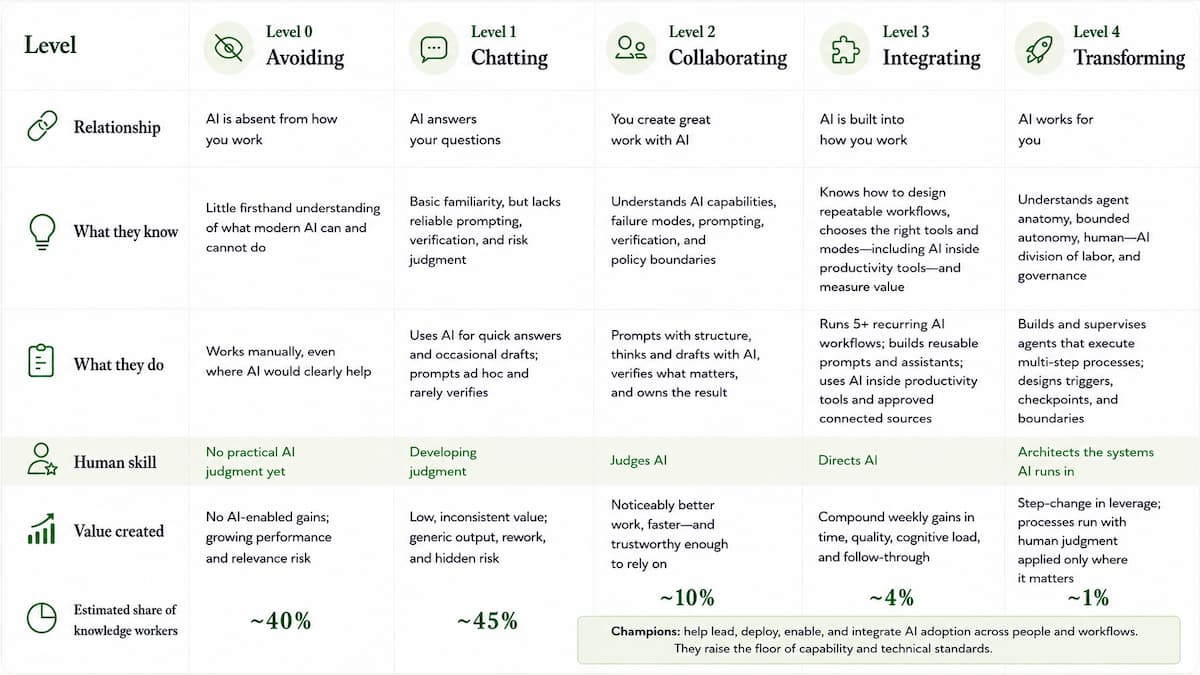
You use AI occasionally but it is not yet part of your day (Level 0 to 1). Start with a free primer to get oriented, then move quickly into a hands-on program. Orientation alone will not change your behavior, and behavior is the whole game. → IBM's Coursera course or Google's intro, then Lead with AI's AI Leader Advanced.
You want AI genuinely embedded in your weekly work, fast (Level 2). This is where most senior leaders should be, and where the compounding starts. → Lead with AI. Over two weeks, at 30 minutes a day, you build a working set of AI assistants around your actual job, with a cohort of senior leaders who keep sharing what works after the course ends.
You are already fluent and want to redesign workflows and lead adoption on your team (Level 3). Your next move is agents and workflow design, not another intro. → AI Agents and Agentic AI Applied to Your Business.
You want to think rigorously about AI strategy and earn a credential → HBS AI Essentials for Business or Cambridge Generative AI in Business.
You want MIT-caliber academic content with a project focus → MIT Sloan Generative AI for Business Sprint or Implications for Business Strategy.
You are rolling this out across a team or company, not just yourself → this is a fluency-at-scale problem, and it is the work behind results like Zapier's 97% adoption and Lloyds' 93% daily usage. → Lead with AI team and company-wide training.
Why Lead with AI is the right choice for most. For the majority of leaders reading this, the goal is not a credential or a theory of AI. It is working capability, and it is closing the personal version of that 87/13 gap. That is exactly what a practical, build-it-yourself program delivers and what a lecture-and-case program does not.
It is also why Lead with AI is rated 4.9 out of 5 across 16 verified reviews, with participants reporting return on investment while they are still taking it. If your goal is academic prestige rather than working capability, the HBS or Cambridge route is the better fit, and I would tell you so directly.
One more thing worth knowing before you choose.
Whatever course you take is a starting point that begins depreciating the day it ends. Models change monthly, and what counted as advanced six months ago is now baseline. We call this AI fluency decay. It is the strongest argument for choosing a program with a community and a refresh rhythm attached, rather than a one-time event you complete and file away.
The course-after-the-course
Here is the thing none of these programs talk about, ours included.
Once you have taken a course, integrated the tools, and clawed back hours from your week, you face the question that AI makes unavoidable: what now?
Most people fill the time with more work. More meetings. More output. More dashboards.
That is the exact mistake. We have built the most productive work culture in history and the least meaningful one. Engagement is at historic lows. Pouring saved time back into the same broken pattern does not fix anything. It just speeds up the burnout.
The leaders I have watched do this well treat AI as a forcing function for asking better questions. Who am I when the tasks are gone? What did I actually become a leader to do? What change do I want to create with my time, now that I have more of it back?
This is the territory FlexOS is built for. The AI courses give you the tools. The harder work, identity, meaning, agency, leadership, is what comes next.
Key takeaways
- Access is not the bottleneck. 87% of workers use AI, but only 13% of organizations perform significantly better for it. That gap is a fluency problem, and it is what the right course closes.
- Practical AI courses (Lead with AI) and academic AI courses (HBS, MIT, Cambridge) serve different goals. For most leaders, working capability matters more than a credential, which is why practical comes first.
- The 56% wage premium for AI-skilled workers is real. So is the risk of using all that productivity to do more of the wrong work.
- For practical AI capability you can use immediately, Lead with AI is rated 4.9 out of 5 across 16 verified reviews and includes a senior leader community that keeps the learning going after the course ends.
- For academic exploration of AI as a strategic subject, HBS AI Essentials for Business is the strongest starting point.
- Fluency decays. Any course is a starting point that depreciates, so choose one with a community and a refresh rhythm attached.
- No course teaches you what to do with the time AI gives back. That is the work that actually matters.
Also available on:


Your Friday Briefing on the
Future of Work
Future Work delivers research-backed insights, expert takes, and practical prompts—helping you and your team capture what matters, build critical skills, and grow into a future-ready force.
Get all-in-one coverage of AI, leadership, middle management, upskilling, DEI, geopolitics, and more.
Unsubscribe anytime. No spam guaranteed.

Stay Ahead in the Future of Work
Get AI-powered tips and tools in your inbox to work smarter, not harder.
Get the insider scoop to increase productivity, streamline workflows, and stay ahead of trends shaping the future of work.
Unsubscribe anytime. No spam guaranteed.

Stay Ahead in the Future of Work
Leading in the future of work is a breeze with FlexOS. Subscribe to our newsletters and stay ahead on AI, Remote Work, and Modern Management.
We curate the most current research, news, trends, and tools to let you work smarter, not harder.
Your Friday Briefing on the
Future of Work
Future Work delivers research-backed insights, expert takes, and practical prompts—helping you and your team capture what matters, build critical skills, and grow into a future-ready force.
Get all-in-one coverage of AI, leadership, middle management, upskilling, DEI, geopolitics, and more.
Unsubscribe anytime. No spam guaranteed.
Stay Ahead in the Future of Work
Get AI-powered tips and tools in your inbox to work smarter, not harder.
Get the insider scoop to increase productivity, streamline workflows, and stay ahead of trends shaping the future of work.
Unsubscribe anytime. No spam guaranteed.
Stay Ahead in the Future of Work
Leading in the future of work is a breeze with FlexOS. Subscribe to our newsletters and stay ahead on AI, Remote Work, and Modern Management.
We curate the most current research, news, trends, and tools to let you work smarter, not harder.
Frequently asked questions
What is the best generative AI course for business leaders in 2026?
It depends on whether you want practical capability or academic exploration. For immediate practical capability, Lead with AI is rated 4.9 out of 5 across 16 verified reviews and is designed for senior leaders who want working AI in two weeks. For academic depth, Harvard Business School Online's AI Essentials for Business is the strongest single program, co-taught by Karim Lakhani and Marco Iansiti. For most leaders, whose goal is working capability rather than a credential, the practical route is the right starting point.
What level of AI fluency do I actually need?
Not everyone needs the same level, and the goal is not to push everyone to the top. Most individual contributors need solid everyday use with AI embedded in a few recurring workflows. Managers and senior leaders should aim to have AI genuinely built into their weekly work. A smaller group of leaders responsible for team processes should be able to redesign workflows and coach others, and a handful of executives should shape enterprise strategy. The right move is to locate yourself honestly, then choose the course that gets you to where your role needs you to be, not the most advanced one available.
How long does it take to learn generative AI for business?
Foundational understanding takes about 3 hours through IBM's free Coursera course. Working knowledge through an academic program takes 4–6 weeks. Practical fluency, where you are actively building AI workflows into your week, can be reached in two weeks through a hands-on program like Lead with AI, or 90 days of consistent practice after a structured course.
Are paid generative AI courses worth it?
For senior leaders, yes. Free courses give you orientation. Paid programs from HBS, MIT, and Cambridge offer faculty access, peer cohorts, and credentials. Lead with AI offers something different: practical AI assistants you build during the course and continue using afterward. The 56% wage premium for AI skills makes the ROI math straightforward across all of these.
Should I take a practical AI course or an academic one?
If you want to actually build working AI into your daily work as soon as possible, choose practical (Lead with AI). If you want to think rigorously about AI as a strategic and business model question, choose academic (HBS, MIT, Cambridge). Both are legitimate. They are not interchangeable. For most leaders, the missing piece is fluency, so practical is the place to start.
Do I need a technical background to take a generative AI course?
No. Every program in this guide is designed for non-technical leaders. HBS, MIT, Cambridge, and Lead with AI all explicitly state that no coding background is required.
What is covered in the Lead with AI course?
Lead with AI covers selecting and using LLMs (ChatGPT, Gemini, Copilot, Claude), advanced prompting frameworks, multimodal AI, building reusable AI assistants, productivity automation across email, writing, data analysis, and meetings, deep research agents, creative assistants for video and presentations, vibe coding, and an introduction to agentic AI.
What should I do after I finish a generative AI course?
This is the question almost no one asks, and it is the most important one. Most leaders fill the time AI gives back with more work. The better answer is to use that recovered time to ask deeper questions about identity, meaning, and leadership. AI fluency is a starting point, not a destination.



.webp)

![[Research Report] Rethinking the Workweek: The Push for Fewer Work Hours, More Life](https://cdn.prod.website-files.com/6442419dcf656a81da76b503/67f62ad0c3f263946ab76bf6_67eb9ea7f1a4e15aa02357f9_67dbcc5cd852e0468b7c1ab5_67d9294873eb0f3d06db0522_67d3e3773b52fb1458bbeca9_67cfeef562a442c6b5cac417_67ce9d783f83a316431e99fb_67c805f1e959c187503b6f9a_67c6b466f85f6718abc84402_67c562f18bb2e90006fefb91_67c01ccf46d56e67e92b4a6c_67becb6ce25a88249e237189_67b590c86adb9081bf7caffb_67a31bbd70980f65543d6140_6790a675ad20d4456fda7112_678f83dd8d45ccd6bdcc0504_Rethinking-the-workweek.avif)


![[Report] The Top 100 AI for Work – March 2024](https://cdn.prod.website-files.com/6442419dcf656a81da76b503/670defe3518d73b50509fa03_6708cccc5300ba0a7c209e41_news-top-100-ai-for-work-march-2024.avif)